Key Takeaways
- 1.A general-purpose chatbot pointed at a whole data room produces confident errors. The fix is scope, grounding and verification, not abandoning AI.
- 2.Customer contracts can prohibit the AI-driven cost cuts a rollup thesis depends on, so contracts have to be read against the thesis, not just for risk.
- 3.Documents show what a company owns. They don't show whether the teams below the C-suite can deliver the value creation plan.
Last reviewed: November 4, 2026.
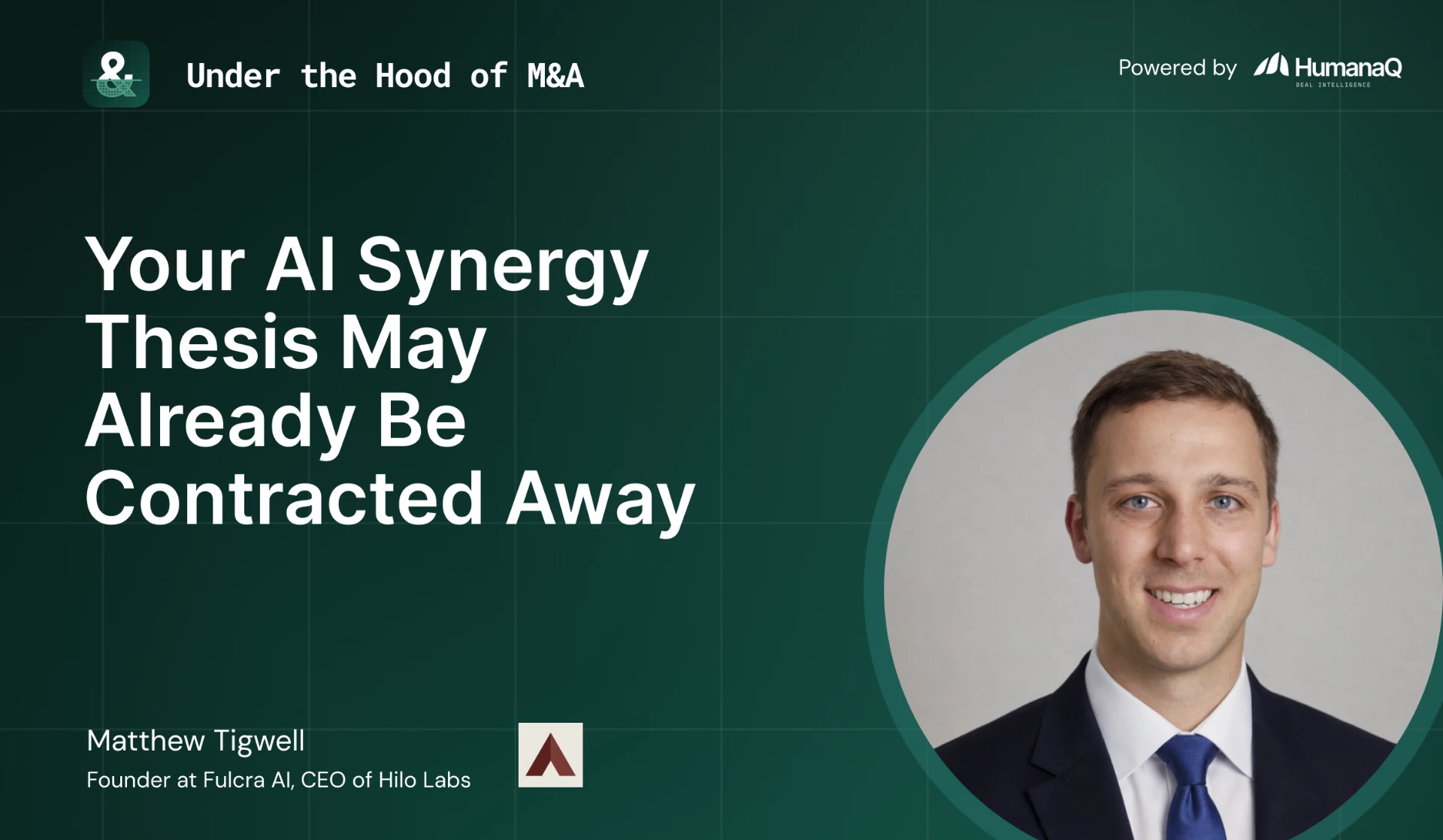
I sat down with Matthew Tigwell, CEO of Fulcra AI, an AI due diligence platform for lower middle market acquisitions. We covered why most deal teams are still using AI in an elementary way, the contract clause that can quietly break a rollup thesis, and where document diligence stops being enough.
Most deal teams already use AI in diligence. Very few are actually getting much out of it. Matt's estimate is that AI handles somewhere around 20–25% of the diligence workload today, mostly through general-purpose chatbots, and mostly in a very elementary way.
"If you hand it a whole data room of 500 documents or 500 pages of documents, you're going to get a ton of hallucination. It's going to be extremely inaccurate."
That is where a lot of AI adoption in M&A currently stalls.
The data room is not a prompt
A couple of people on the deal team, usually the younger ones, start building with whatever model the firm has licensed. They drop the data room in, run the analysis, double-check it, and find a large share of it wrong. The conclusion they reach is that the technology isn't ready.
The technology isn't the problem. The setup is. Large language models struggle with volume and with gaps, and a data room is both. Ask one model to read everything at once and it will answer confidently, whether or not the source supports it.
What works in practice is narrower. One question at a time, run against the documents that answer it. Every finding traced back to a page. A named person who signs off on the exceptions before anything reaches the investment committee. Slower than a single prompt. Much faster than a team reading every page.
There's a second failure. The team that gives up on AI after one bad run loses some speed. The team that trusts everything it produces loses judgment.
Interested in where AI in M&A is heading? Join our AI in M&A LinkedIn Group to exchange ideas with others working across the deal lifecycle.
The clause that breaks the thesis
A private equity play is the rollup: buy the company, automate a large part of the work with AI, take the cost out. It shows up in the investment thesis as a margin story.
Some of those targets have customer MSAs that prohibit the use of AI on the work the customer is paying for.
"PE's thesis is, hey, we want to use AI to do half the work after we buy it to cut costs, but… some of the revenue you can't use AI."
If those clauses cover a meaningful share of revenue, the synergy case is broken before the deal closes. Standard contract review won't necessarily flag it, because it asks what could hurt you. The question here is different: what stops you doing the thing you're paying for?
That is a thesis question, and it only gets answered if someone takes each value creation lever in the IC memo and checks it against the contracts that could block it. The clause is a document. The risk lives in the plan.
Bolt-ons are where diligence gets thinner
Outsourced diligence economics break down in the lower middle market. On Matt's numbers, spending around $300,000 to outsource diligence on a $10–20 million deal simply isn't feasible. So deal teams do it themselves, inside a limited exclusivity window.
Bolt-ons make that worse. A sponsor building a platform might buy ten companies in the $5–50 million range. Each one is judged mostly on EBITDA and price, none of them justifies a full advisory engagement, and the deal team can't give all ten the depth it would give the platform deal.
Individually, each shortcut looks reasonable. Together, they add up. If ten add-ons carry the value creation plan, ten thin diligence reports become one large blind spot. The answer isn't more advisors. It's a repeatable diligence scope that every add-on goes through in full, at a cost the deal size can carry.
The people the plan actually depends on
Even complete document diligence has a ceiling. When private equity looks at a target's team, it usually looks at the C-suite. Keep current leadership or bring in an operating partner? Can they execute? It's a fair question, and an incomplete one.
"A lot of the time with the value creation plan or the investment thesis, it's going to require more than just the C-suite to execute on it… it's going to be a teamwide initiative."
The plan is delivered two or three levels down: the finance teams that have to consolidate, the commercial teams that have to cross-sell, the operations teams that have to absorb a new way of working. No data room shows how those teams make decisions under pressure, or how far apart the two organizations really operate.
Plenty of firms now say they care about the people they acquire. Far fewer test whether those people can deliver the plan before they sign.
Choosing the tools without adding the risk
All of this assumes the tool itself can be trusted with a data room. The vetting comes down to a few things.
- Real security certifications.
- A build team with experienced developers who have shipped platforms before, rather than a product vibe-coded from scratch.
- M&A expertise on the team or on an advisory board that actually shapes the product.
- Proof of ROI on real deals: time saved and issues caught, not just usage.
AI is making diligence cheaper. It isn't making judgment optional. The advantage now belongs to the deal teams that test the thesis, not just the documents, and that includes the people who have to deliver it.
Interested in where AI in M&A is heading? Join our AI in M&A LinkedIn Group to exchange ideas with others working across the deal lifecycle.
This conversation is part of a series running through the Under the Hood of M&A newsletter.
Frequently Asked Questions
- How much of M&A diligence does AI handle today?
- Matthew Tigwell estimates around 20 to 25% of the diligence workload, mostly through general-purpose chatbots used in an elementary way.
- Why does AI hallucinate on a data room?
- Large language models struggle with volume and gaps. Asked to read hundreds of documents at once, a model answers confidently whether or not the source supports it. Scoped questions, page-level sourcing and human sign-off fix this.
- How can a customer contract break an AI synergy thesis?
- Some customer MSAs prohibit the use of AI on the work the customer pays for. If those clauses cover a meaningful share of revenue, the planned AI cost reduction cannot be delivered on that revenue.
- Why is bolt-on diligence often thin?
- Outsourced diligence costs do not fit small deal sizes, so deal teams do it themselves within tight exclusivity windows. Across ten add-ons, those shortcuts add up to one large blind spot.
- What should deal teams check when choosing an AI diligence tool?
- Real security certifications, an experienced build team, M&A expertise that shapes the product, and proof of ROI on real deals: time saved and issues caught.