The stages, the applications, and who is deploying them.
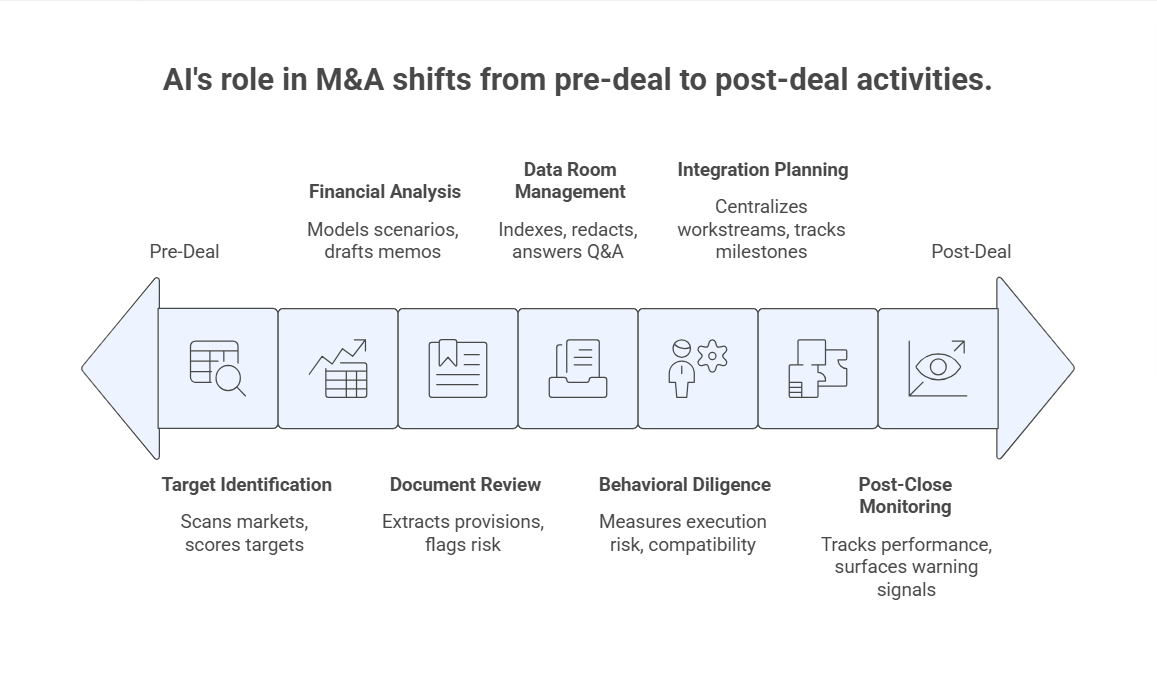
AI has moved from a peripheral experiment to a core part of how serious M&A practitioners work. Firms reporting moderate to high gen AI adoption in their M&A activities record an average cost reduction of roughly 20%, with 40% reporting deal cycles that are 30 to 50% faster. But "AI in M&A" covers a wide range of applications that operate at very different stages and serve very different purposes. Understanding what AI actually does, and where, is more useful than the general claim that it is transforming the industry.
This article breaks it down simply: what AI is doing at each stage of the deal, and who is using it.
Summary: AI in M&A by Deal Stage
| Deal Stage | What AI Does | Primary Users | Representative Tools |
|---|---|---|---|
| Target Identification | Scans private markets, scores targets, detects acquisition signals | PE, corp dev, investment banking | Grata, Blueflame AI, AlphaSense |
| Financial Analysis | Dynamic modelling, scenario analysis, memo drafting | PE deal teams, investment banking | Pigment, Blueflame AI |
| Document & Contract Review | Extracts provisions, flags risk clauses, speeds legal review | Law firms, PE counsel, corp legal | Kira, Spellbook, Harvey |
| Data Room Management | Auto-indexes, redacts, answers Q&A across documents | Sell-side advisors, corp dev | Datasite, Intralinks, DealRoom |
| Behavioral Diligence | Measures execution risk, behavioral compatibility, leadership patterns | PE, corp dev, family offices | HumanaQ |
| Integration Planning | Centralizes workstreams, tracks milestones, models integration scenarios | Corp dev, PE operations | DealRoom, Ansarada, Midaxo |
| Post-Close Monitoring | Tracks performance vs. model, surfaces early warning signals | PE portfolio teams, corp acquirers | AlphaSense, Blueflame AI |
Stage 1: Target Identification
What AI Does Here
AI scans private company databases, news sources, regulatory filings, and market data to identify acquisition targets that match a buyer's criteria, at a scale and speed no human research team can replicate. Natural language processing tools monitor news, social media, and industry publications to detect early signals about potential targets, tracking sentiment shifts and emerging business challenges that might make a company receptive to acquisition offers.
Semantic search engines, which understand meaning rather than just keywords, allow deal teams to describe what they are looking for in strategic terms and receive a scored, ranked list of candidates across millions of companies, including private businesses that do not appear in conventional databases.
Who Is Doing It
- PE firms running active deal origination programs
- Corporate development teams at strategic acquirers
- Investment banks building target lists for clients
Tools in use: Grata, Blueflame AI, AlphaSense
AI has made off-market deal sourcing in the private markets tractable at scale for the first time. In one documented case, an AI scouting platform helped a corporate development team identify and score more than 500 potential targets in less than a day, ultimately producing three completed acquisitions.
Stage 2: Financial Analysis & Valuation
What AI Does Here
AI accelerates the construction and iteration of financial models, enabling real-time scenario analysis, sensitivity testing, and LBO modelling that previously required days of analyst time. Generative AI drafts investment memos, market overviews, and preliminary valuation analyses from structured inputs, compressing the time between initial screening and investment committee presentation.
Feeding generative AI with sales data, pricing models, and customer demographics from both companies can quickly identify cross-sell opportunities, allowing acquirers to include higher revenue synergy projections with greater confidence.
Who Is Doing It
- PE deal teams building LBO models
- Investment banking analysts preparing pitch books and CIMs
- Corporate development teams modelling deal scenarios
Tools in use: Pigment, Blueflame AI, AlphaSense
AI does not replace financial judgment. It removes the mechanical constraint, the hours spent building and reformatting models, so that analyst time can be spent on the judgment calls that actually determine valuation accuracy.
Stage 3: Due Diligence
Due diligence is where AI has had the most immediate and measurable impact. It operates across three distinct diligence dimensions.
3a. Document & Contract Review
AI significantly accelerates the due diligence process by automating document review and data analysis. NLP technology can examine thousands of contracts, financial statements, and legal documents in hours rather than weeks. Smart contract analysis tools identify potential risks, unusual clauses, and compliance issues, flagging them for human review while automating routine processing tasks.
AI extracts specific provisions, change-of-control clauses, assignment restrictions, indemnities, reps and warranties, across hundreds of documents simultaneously, flags anomalies, and produces structured outputs that allow lawyers to focus review time on the issues that matter rather than the documents that do not.
Who Is Doing It
- M&A law firms conducting legal diligence
- In-house legal teams at PE funds and corporate acquirers
- Sell-side advisors preparing disclosure schedules
Tools in use: Kira, Spellbook, Imprima AI, Harvey
Tools like Kira achieve 90%+ accuracy on standard contract clauses. Boutique banks report that AI tools allow junior lawyers and bankers to handle 2 to 3 times more live deals simultaneously.
3b. Data Room Management
AI auto-indexes documents on upload, detects duplicates, redacts sensitive information, and answers buyer Q&A queries by searching across the entire data room. This compresses sell-side preparation time and reduces the back-and-forth between buyer and seller teams during the formal diligence period.
Who Is Doing It
- Sell-side advisors managing data room processes
- Corporate development teams on both sides of the transaction
- PE fund counsel in formal diligence
Tools in use: Datasite, Intralinks DealCentre AI, Ansarada, DealRoom
AI-enabled data room management is now a baseline expectation in competitive processes, not a differentiator. Datasite helped HSBC acquire SVB UK in just 36 hours by enabling secure, accelerated due diligence in a time-critical scenario.
3c. Behavioral & Execution Diligence
This is the dimension of diligence that financial and legal AI tools do not address, and the one most directly connected to whether a deal delivers its projected return post-close. AI-powered behavioral language analysis measures how organizations actually behave: how decisions are made in practice, how leadership responds to pressure, whether the target's behavioral profile is compatible with the acquirer's governance model.
Rather than asking management teams to characterize their own culture, which produces managed, favorable self-presentation, behavioral AI extracts patterns from natural language responses to open-ended questions, measuring the subconscious behavioral signals that self-report consistently misses. The output is decision-relevant execution risk intelligence: specific behavioral compatibility scores, risk pattern identification, and integration planning implications.
Who Is Doing It
- PE investors conducting pre-LOI behavioral screening
- Corporate acquirers assessing execution risk in cross-border deals
- Family offices evaluating external CEO and partner appointments
- Roll-up operators assessing portfolio-level behavioral compatibility
Tools in use: HumanaQ
Behavioral diligence is the last major dimension of execution risk that AI has addressed at deal speed. Every other diligence tool measures what the organization has: financial assets, legal obligations, operational infrastructure. Behavioral diligence measures whether the organization can execute. That is the variable most directly upstream of ROI.
Stage 4: Integration Planning & Execution
What AI Does Here
AI supports integration planning by centralizing workstream management, automating milestone tracking, and maintaining visibility across the many parallel workstreams that integration requires. More advanced applications use AI to model integration scenarios, identifying where operational systems are compatible, where they will require investment to align, and what the likely timeline and cost of full integration looks like.
After the merger, AI assists with data integration and monitoring the success of the deal, providing real-time tracking of integration milestones and early warning signals for workstreams that are falling behind plan.
Who Is Doing It
- Corporate development and integration management offices
- PE portfolio operations teams managing simultaneous integrations
- Operating partners at PE firms overseeing 100-day integration plans
Tools in use: DealRoom, Ansarada, Midaxo
AI in integration management addresses process coordination. It does not address the behavioral execution risk that determines whether the people responsible for integration workstreams will actually deliver them, which is why behavioral diligence before close matters as much as integration tooling after it.
Stage 5: Post-Close Monitoring
What AI Does Here
AI monitors portfolio company performance against deal model assumptions in real time, flagging divergences between projected and actual performance, tracking operational KPIs, and surfacing early warning signals before they become material value leakage. In PE contexts, this enables more active and informed portfolio management across a larger number of investments than traditional reporting cadences allow.
Who Is Doing It
- PE portfolio management and value creation teams
- Corporate acquirers monitoring integration performance
- Family offices overseeing direct investment portfolios
Tools in use: AlphaSense, Blueflame AI
AI converts portfolio monitoring from a quarterly reporting exercise to a continuous intelligence function, giving operators the early warning capability to intervene before performance divergence becomes structural.
About the Author
Simone Vascotto is the Founder of HumanaQ, the AI-powered platform for Cultural Due Diligence and leadership alignment in M&A.