Key Takeaways
- 1.Human capital risk is not one checkpoint during diligence. It is a continuous thread from pre-approach through exit.
- 2.Before approach, the question is leadership concentration risk: does the business run on systems or on one or two individuals.
- 3.Every synergy assumption in the deal model is a behavioral assumption wearing a financial label.
- 4.The window between LOI and close is when trust is built or eroded, and almost nobody is watching it.
- 5.At Day 30 the financial numbers have not moved, but the cause of a future miss is already measurable.
- 6.At exit, a documented re-measurement trail turns the people story into a data-backed asset for the next buyer.
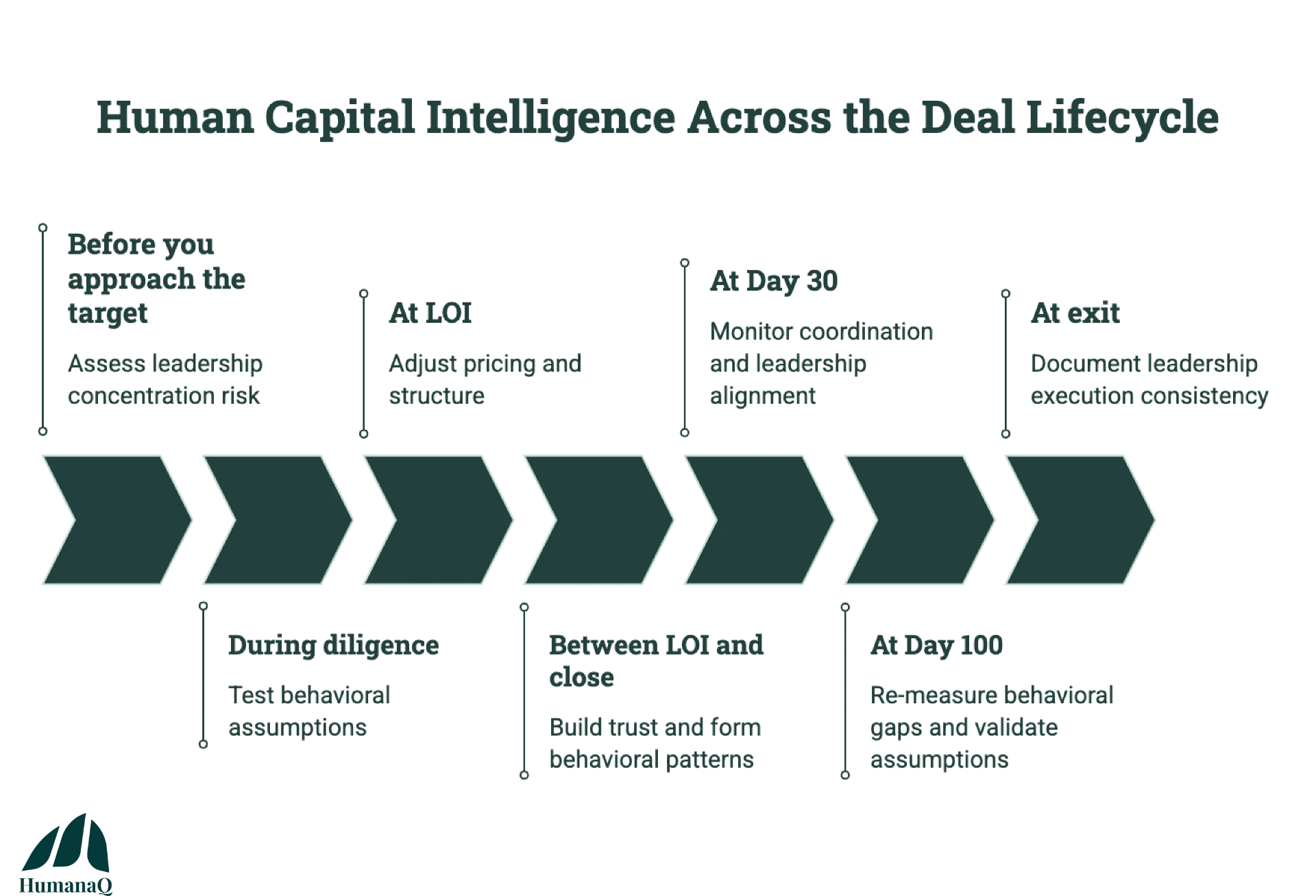
The mistake most acquirers make is not ignoring human capital risk entirely. It is treating it as a single checkpoint, usually a management presentation during diligence, rather than a continuous thread that runs from pre-approach through exit.
Before you approach the target
At this stage the question is whether the thesis is even buildable with the people currently in place. Leadership concentration risk sits at the center of it. Whether the business runs because of systems and process or because of one or two individuals the model has quietly priced as permanent, without ever stating that assumption out loud.
The answer shapes whether you approach at all. It also shapes what the opening conversation looks like. Approaching a business that runs on one founder's judgment requires a different opening than approaching one with distributed leadership and documented process. Most acquirers make this distinction based on instinct or a quick read of the org chart. It is answerable with more precision than that, before a single conversation with the target has happened.
During diligence
This is where behavioral assumptions get tested rather than inherited. How decisions actually get made inside the target. Where informal authority sits relative to the org chart. Whether the leadership team that built the business has the behavioral profile to operate inside a new ownership structure, or whether their success to date was inseparable from an autonomy they are about to lose.
Every synergy assumption in the deal model is a behavioral assumption wearing a financial label. Cost synergies assume two functions will coordinate. Revenue synergies assume two commercial teams will trust each other enough to share pipeline. Diligence is the moment to find out whether those assumptions hold, while there is still time to reprice, restructure, or walk if they do not.
At LOI
Pricing. Structure. Earnout design. All three change once you know which leaders the thesis actually depends on, how concentrated that dependency is, and what the attrition risk looks like if the integration moves at the pace the model assumes.
A deal priced without this information is a deal priced on hope. Not because the financial model is wrong, but because the financial model has an unstated assumption baked into every synergy line, and nobody has checked whether that assumption is true. The earnout structure that gets built around behavioral evidence protects the specific value the deal depends on. The one built without it protects a number the model imagined.
Between LOI and close
The formation window. This is the period when people inside the acquired organization are deciding how they feel about the acquirer before any formal integration structure exists to shape that feeling for them.
Trust is either being built or eroded during this window, whether or not anyone is watching. Behavioral patterns that will define the first 100 days are already forming here, quietly, well before Day 1 arrives. Most acquirers are not watching this window at all. Attention is on legal completion, financing, and regulatory approval. The organizational and relational reality of the deal is running unmonitored during exactly the period when first impressions of the new ownership are being set.
At Day 30
The operational data is still catching up. The behavioral signals are already visible.
Whether the coordination the synergy plan depends on is holding. Whether the leaders behind the largest assumptions are still working together or quietly pulling apart. The financial number has not moved yet, because financial numbers lag. The cause of the future miss, if there is going to be one, is already present and already measurable. This is the earliest point in the integration where a problem can be caught before it becomes expensive to fix.
At Day 100
Re-measurement. Whether the behavioral gaps identified at Day 30 have narrowed or compounded. Which interventions worked. Which assumptions in the original model have been validated and which need to be repriced against what the data now shows.
This produces a specific board narrative that most integrations cannot currently tell: risk identified early, moves made in response, results independently measured. Not a status report claiming things are on track. A documented sequence of detection, intervention, and outcome that an operating partner can actually stand behind in front of an investment committee.
At exit
The behavioral profile of the leadership team is now a due diligence input for the next buyer. Documented execution consistency under pressure. Named owners with measured accountability against specific outcomes. A re-measurement trail that runs from Day 30 through the full hold period.
This turns the people story of the business from a qualitative narrative, competent management team, strong culture, into a data-backed asset with a track record behind it. The next buyer's diligence on leadership execution risk becomes shorter and more confident, because the evidence already exists rather than needing to be reconstructed from scratch through fresh interviews.
The information changes at every stage. So does what you can do with it.
Each stage asks a different question and enables a different decision. Pre-approach asks whether the deal is buildable at all. Diligence asks whether the model's behavioral assumptions hold. LOI asks how to price and structure around what you now know. The formation window asks whether trust is being built while nobody is watching. Day 30 asks whether the earliest signals match the plan. Day 100 asks what has changed and what needs repricing. Exit asks what evidence exists to hand to the next buyer.
The value is not in having behavioral intelligence. It is in having it at the specific moment each of those questions needs answering, before the moment has passed and the only option left is finding out what already happened.