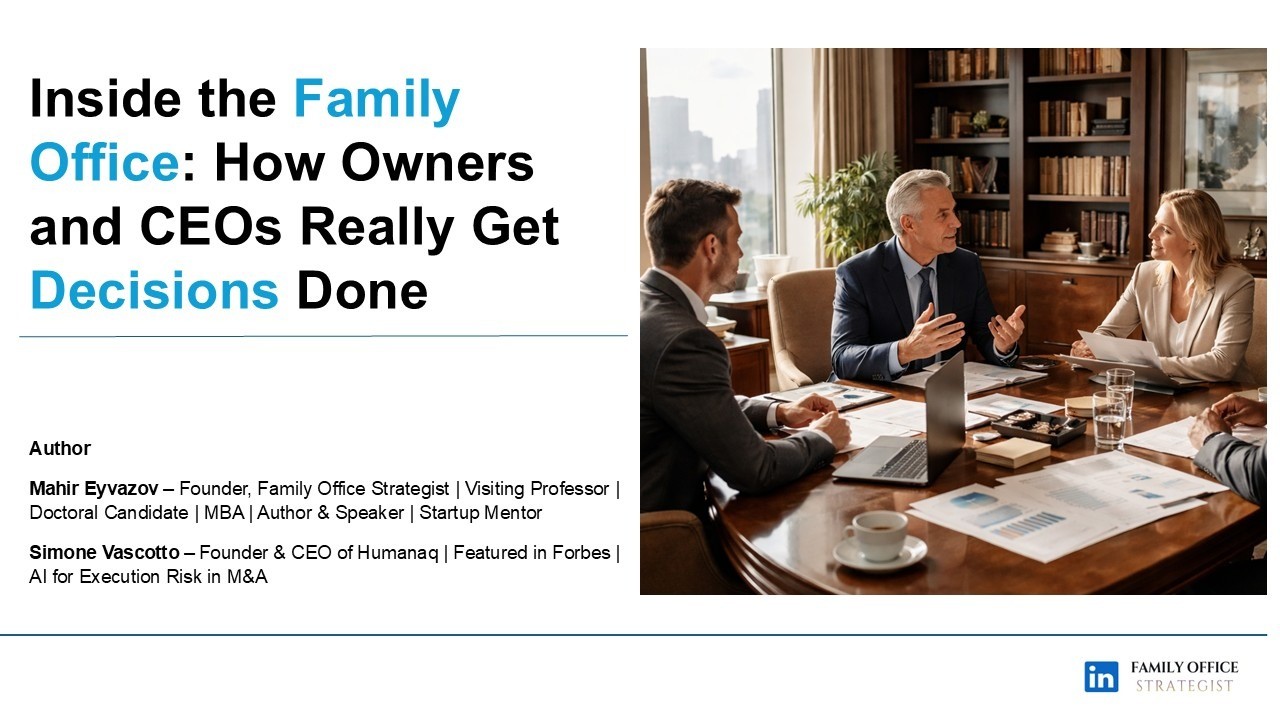
How decision rights, informal authority, and family dynamics shape execution and why these patterns determine whether external CEOs and partners succeed or fail.
By Mahir Eyvazov - Founder, Family Office Strategist | Visiting Professor | Doctoral Candidate | MBA | Author & Speaker | Startup Mentor
By Simone Vascotto - Founder & CEO of HumanaQ | Featured in Forbes | AI for Execution Risk in M&A
Family offices now professionalize governance at speed: boards, committees, investment policies, and reporting frameworks are increasingly standard. UBS's Global Family Office Report 2025 notes that more than half of single family offices have recently upgraded governance structures as they prepare for an estimated 80 trillion USD generational wealth transfer.1 Yet in many offices, strategy still stalls after the board signs off. Deals get re-opened. Key hires leave early. Projects that looked "approved" on paper quietly lose momentum.
Behind this pattern sits a simple reality: every family office runs two operating systems. The first is formal documents, committees, decision rights. The second is informal who must be consulted, which relationships carry real weight, and how the family actually makes up its mind. External CEOs and partners who learn only the first system fail predictably. Those who learn both have a chance to succeed.
How decisions actually get made
In institutional contexts, documented decision rights are a good proxy for actual authority. In a family office, they usually describe the formal sign-off for decisions already shaped elsewhere.
A typical pattern: an external CEO brings a major allocation or organisational change to the investment committee and board. The paper is strong, the discussion is constructive, and formal approval is granted. On Monday, the team starts implementation only to discover resistance from a family member who was not consulted, or a long-serving executive who has seen a similar idea fail before. Nothing in the formal process signalled this, yet it now governs what happens.
For owners and principals, this matters because it determines whether the office can execute at the speed and quality they expect. For FO leadership, it explains why "we had approval" still turns into months of friction. For advisers and partners, it explains why deals that look aligned in the room become slow and difficult in practice.
Formal approval is necessary in a family office; it is rarely sufficient. The informal consultation and alignment that precede formal decisions are where governance actually happens.
External executives who build this into their operating rhythm by asking "who else needs to be in this conversation before we go to committee?" tend to navigate the system more effectively.
The authority that appears nowhere on the org chart
Most family offices have one or more long-serving executives often a CFO, COO, or senior assistant who carry institutional memory no document can capture: which deals the principal regrets, which advisers have earned deep trust, which governance experiments the family tried and quietly abandoned.
A new CEO who proposes a change this person doubts is not meeting generic resistance; they are bumping into informed judgment from someone who has watched the family's operating system evolve over years. Treating that scepticism as something to "manage around" misses the point.
For FO leaders, the practical move is engagement rather than circumvention:
- Ask explicitly, "What have you seen us try before that looked like this?"
- Test proposals against remembered failure modes before launching them.
For owners, paying attention to who holds this informal authority and making sure they are aligned with the new CEO is a continuity decision, not a courtesy.
Three family dynamics that drive execution
Deloitte's work with family enterprises stresses that governance only works when it accounts for ownership and family dynamics, not just structures.2 In family offices, three patterns show up repeatedly.
1. Founder dependency
In founder-built systems, the operating model routes through the founder's personal judgement and relationships in ways even they may not fully see. When a successor or external CEO steps in, formal authority transfers, but clients, staff, and partners still orient toward the founder. Without a deliberate transition design where the founder visibly backs the new leader and gradually redirects decision traffic execution risk remains high, regardless of what the organisation chart says.
2. Sibling authority dynamics
Where siblings or cousins share ownership and roles, formal equality often masks informal hierarchies who has been involved longest, who is seen as "the one who understands the business," who others defer to on people decisions. External executives who bring decisions to the formally correct signatory and then discover that the outcome depends on a sibling conversation they were not aware of are encountering the real governance architecture.
3. Generational value divergence
PwC's 2023 US Family Business Survey found that while 78% of respondents see protecting the business as their top long-term goal, only 34% had a robust, documented, and communicated succession plan.3 In many family offices, younger generations are already in the room, bringing different views on risk, impact, and time horizon. The result is an ongoing internal negotiation about direction that rarely appears in the investment policy statement but shapes every significant decision.
For advisers and partners, recognizing these dynamics early rather than assuming a single, unified "client view" is critical to structuring realistic timelines and expectations.
Using structured assessment instead of guesswork
Historically, understanding a family office's informal operating system required years inside the environment. Today, more offices are using automated structured leadership assessment psychometrics, behavioural interviews, and reference triangulation to reduce guesswork when appointing external CEOs or key partners.
Meta-analyses in organizational psychology show that well-designed cognitive assessments can materially improve predictions of leadership performance and fit, especially when combined with structured interviews. In a family office context, this is less about labelling someone "good" or "bad," and more about asking:
- How does this executive typically make decisions fast and top-down, or through consultation and consensus?
- How do they handle ambiguity, shifting boundaries, and informal influence?
- How do they build and maintain trust in close, relationship-driven environments?
For owners and FO boards, the goal is not to outsource judgement to a test. It is to surface behavioural questions explicitly before an appointment is made, not 18 months into a mandate when friction has already materialised.
Why external appointments fail and what predicts success
When external CEOs or senior executives fail in family offices, the pattern is consistent:
- They assume formal authority equals operational mandate, then interpret informal resistance as "change aversion" rather than a signal that key people or branches were not brought along.
- They import institutional timelines for change, underestimating the relational pace required when decisions affect identity, history, and family cohesion.
- They treat scepticism from long-serving staff or family board members as a problem to overcome, instead of as data about how the system has responded to similar moves in the past.
Those who succeed tend to operate differently:
- They map the informal operating system early who must be consulted, whose view the principal values, where historic sensitivities lie.
- They treat long-serving executives as partners in transition, not obstacles.
- They calibrate their authority expectations to the family's relational reality, building trust before leaning on formal powers.
- They remain genuinely curious about the family's history, seeing it as operational intelligence rather than background colour.
For a principal or FO board considering an external CEO, one practical step before any appointment is simple: ask for a short memo that describes how the candidate intends to learn the family's "second operating system" in the first 90 days and how they have done this in prior roles. If the answer is thin, the risk is not only strategic; it is structural.
References
- UBS. (2025). Global Family Office Report 2025.
- Deloitte. (2025). Governance & Succession Advisory - Family Office Enterprise.
- PwC. (2023). US Family Business Survey 2023.
- American Psychological Association - leadership assessment summaries on the predictive validity of cognitive and personality tests for job performance.
This article is for informational purposes only and does not constitute investment, legal, or any other advice.
HumanaQ delivers behavioral due diligence for M&A, private equity, roll-ups, and family office transactions. Powered by Cognitive NLP through a partnership with MiliMatch.