Most deals don't fail because the strategy was wrong or the financial model was off. Deals fail to create value because the erosion of trust and alignment begin long before anyone notices.
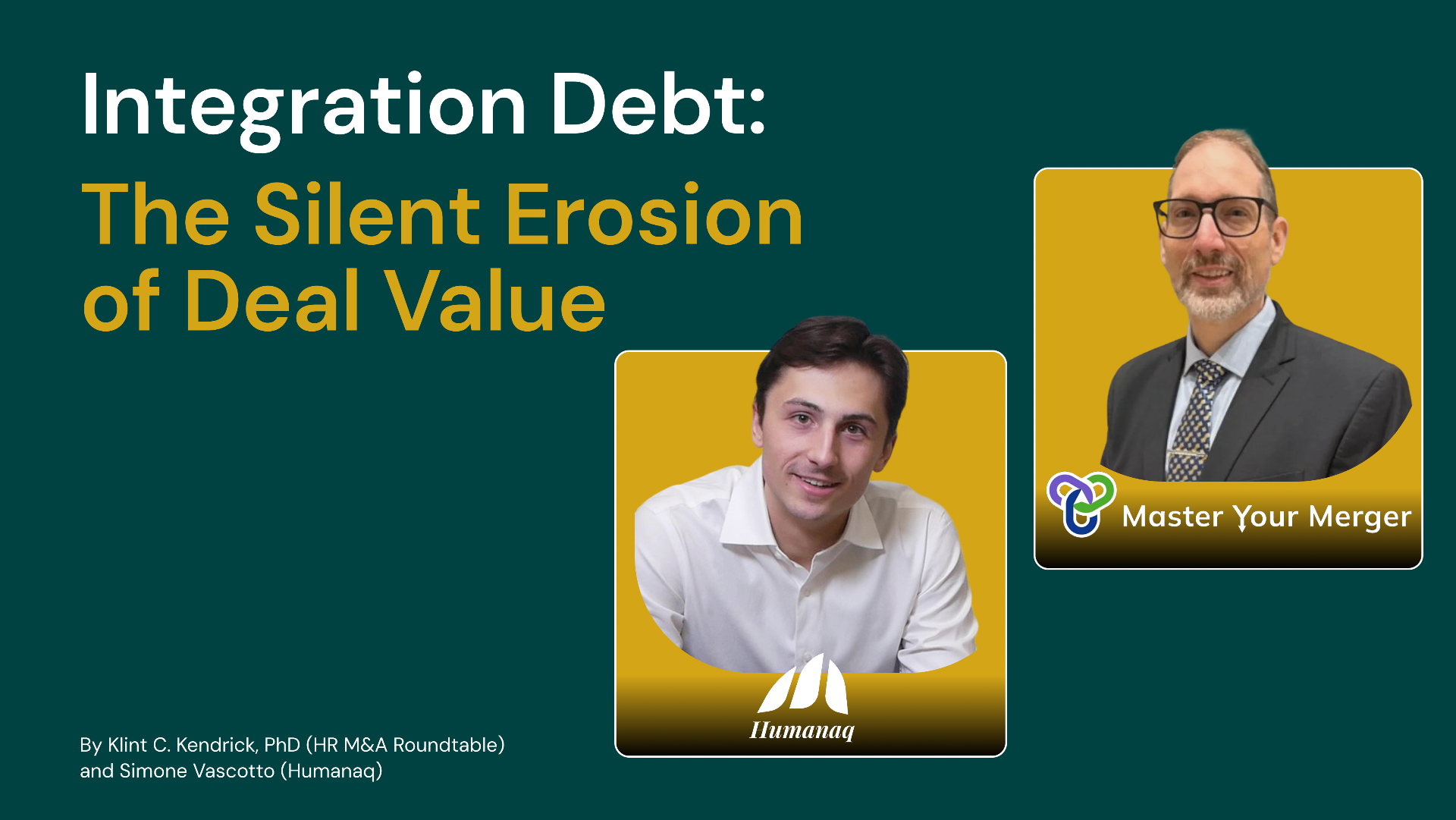
Integration is the most critical phase of any merger or acquisition. While the transaction itself is complete at signing, the real work begins once two organizations attempt to function as one. During this process, misalignment between people, systems, and expectations can build quietly, creating what Dr. Klint Kendrick refers to as Integration Debt - the compounding cost of delayed alignment and unresolved decisions.
A 2024 study by Instill found that up to 60% of M&A failures post-close can be traced back to cultural misalignment. Mercer's Cultural Integration Snapshot Survey reinforces the financial impact, reporting that cultural issues erased at least $1 million of value in over 70% of deals, with more than $5 million in value lost in nearly a quarter of them. This is the silent erosion leaders must confront early, and why innovators like Simone Vascotto are applying AI to help detect Integration Debt before it undermines value creation.
Understanding Integration Debt
Much like tech debt reflects gaps left in code, Integration Debt reflects the gaps in trust, clarity, and alignment that form when leaders delay critical integration work. Experienced M&A leaders have experienced the compounding cost of forcing misaligned people, systems, and norms to "fit" before the organization is truly ready. When cultural alignment, communication clarity, organizational structure, and leadership cohesion are not addressed early, integration debt begins to accumulate, silently eroding execution, momentum, and value.
Integration debt compounds quietly and becomes increasingly costly to resolve as integration progresses. Each unresolved behavioral gap adds interest: slower decisions, rising attrition, and the quiet decay of trust. And the financial impact is real: what begins as minor misalignment often grows into millions of dollars in delayed synergies, rework, and preventable turnover.
The symptoms are easy to recognize:
- Strategic initiatives stall as leaders interpret the same goals differently.
- High performers exit, taking institutional knowledge, customers, and future value with them.
- Workarounds multiply until teams no longer remember which synergies matter, what they mean, or who owns them
On paper, the deal succeeds. In practice, the enterprise behaves like two companies sharing a single name, all while value washes away.
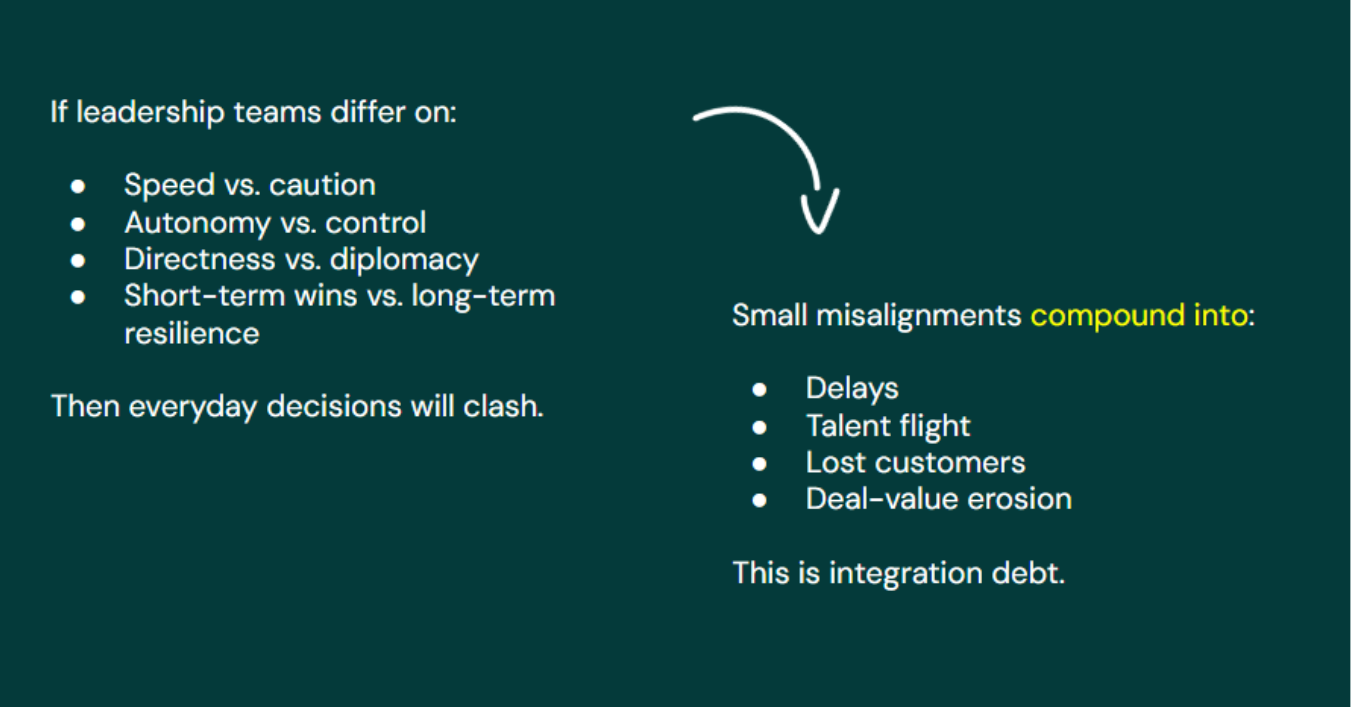
Simply closing the deal doesn't lead to cultural alignment. In reality, most organizations discover deep differences in how teams see themselves, and how they communicate, collaborate, and make decisions. Bain & Company's 2023 M&A report reveals that 75% of acquirers face significant cultural challenges, making alignment and retention critical from Day One.
Alignment
Alignment is the first place Integration Debt becomes visible. Even before close, leaders drift in how they interpret priorities, communicate expectations, and define "what good looks like." When two organizations come together without a shared understanding of norms, decision rights, or cultural expectations, misalignment becomes the initial fault line, leaving value capture on shaky ground.
Many leaders still treat culture as a soft variable, but it is a structural risk factor. Teams bring deeply embedded habits, unwritten rules, and informal networks that rarely map neatly onto a new environment. If these dynamics aren't surfaced early, they become the first layers of Integration Debt.
This is where Simone Vascotto and HumanaQ change the game. Instead of relying on intuition or sporadic surveys, HumanaQ analyzes real behavioral signals. These are the human patterns that silently shape execution. Their platform detects early indicators such as diverging interpretations of priorities, shifts in sentiment and trust, slowing collaboration, and rising dependence on informal workarounds.
And it does this before the deal closes.
HumanaQ's cultural intelligence gives deal teams a data-backed view of where two organizations align, where they differ, and where friction is likely to emerge. These pre-close insights allow acquirers to understand, with precision, where Integration Debt is already forming.
Armed with this data, HR and the IMO enter the conversation earlier and with more influence. They can:
- shape synergy sequencing
- inform leadership selection
- anticipate friction points
- design targeted interventions, and
- prepare leaders for integration realities
When AI tools reveal misalignment early, leaders can see the first signs of erosion and reinforce the weak points long before the post-close landslide ever begins.
Retention
Retention is where the early erosion of misalignment becomes visible. Cultural friction, unclear expectations, and inconsistent communication accumulate quietly. Then, suddenly, the first wave of exits begins. This is the landslide phase of Integration Debt.
According to Kin&Co, 45% of employees leave within the first-year post-transaction, and up to 75% exit within three years, largely due to cultural misalignment or poor change in communication. The question for acquirers is not whether attrition will occur, but how preventable it might have been had the early fault lines been reinforced through stronger alignment.
The first 100 days are critical. Employees are scanning for signals:
- Do I still have a future here?
- Do my leaders know where we're going?
- Do I understand how to succeed in this new environment?
If leaders cannot answer these questions with clarity and consistency, retention becomes a structural risk.
Employee exits follow a predictable pattern.
- Self-efficacy drops. As research by Dr. Liz Lance shows, employees who don't feel confident operating in the new environment will underperform and eventually leave, taking critical relationships and institutional know-how with them.
- Strategic confusion grows when employees cannot see how their work connects to the future of the combined company or how their ways of working must shift.
- Uncertainty rises as reporting lines, job security, and priorities remain vague.
- And then attrition contagion begins: when a respected colleague leaves, peers are 5–6x more likely to follow.
This is the moment the landslide hits.
In a 100-person firm, the cost of excess M&A-related attrition can exceed $4M in the first year alone.
And when delayed decisions, lost talent, and disengagement slow the organization, Integration Debt can quietly erode 5–10% of annual synergy value for every month the organization struggles to regain traction. For many deals, that means millions in preventable erosion, all rooted in early misalignment.
This is why alignment data from cultural due diligence is so critical. As Simone Vascotto's work at HumanaQ shows, real-time behavioral signals can reveal how an acquired workforce thinks and collaborates, allowing leaders to reinforce early fault lines on Day 1, before slow erosion quickly becomes a costly retention landslide that destroys value.
Conclusion
Integration Debt is a structural risk within M&A. Financial and operational models forecast strategic potential, but they rarely account for the behavioral realities of how people adjust to new structures, leaders, and expectations. When misalignment and uncertainty accumulate, they erode value long before anyone notices, and waves of attrition become the landslide revealing how much debt had quietly formed.
Addressing Integration Debt early, preserves leadership stability, reduces attrition, and accelerates post-deal performance. In the end, prevention, rather than recovery, determines whether the deal delivers value.
About the Authors
Klint C. Kendrick, PhD, SPHR is the founder of the HR M&A Roundtable and a recognized expert in the human capital aspects of mergers and acquisitions. With decades of experience advising organizations on integration strategy, he helps leaders understand and address the people-side risks that determine deal success.
Simone Vascotto is founder of HumanaQ, where he pioneers AI-powered cultural due diligence solutions that enable private equity firms and strategic acquirers to measure and predict organizational compatibility, behavioral friction, and execution probability before deals close.