Every year, companies spend trillions on mergers and acquisitions, chasing growth, efficiency, and strategic advantage. Yet most deals still miss their financial targets. The reasons are familiar: market shifts, overvaluation, execution hurdles. But beneath those explanations lies a quieter, more consistent failure: human misalignment.
When two organizations merge, it isn't their balance sheets that must integrate, it's their behaviors.
The Mirage of Cultural Alignment
In most deals, "culture" appears as a line item near the end of diligence, acknowledged, discussed, then deferred. Executives assure themselves that shared values will ensure alignment. But culture isn't what's written in handbooks or repeated in town halls.
It's how people interpret direction, set priorities, and make tradeoffs when pressure mounts.
When those behavioral patterns clash, even the best deal logic begins to unravel. The cost doesn't show up as a single event; it accumulates quietly in lost decisions, duplicated work, and leaders talking past one another.
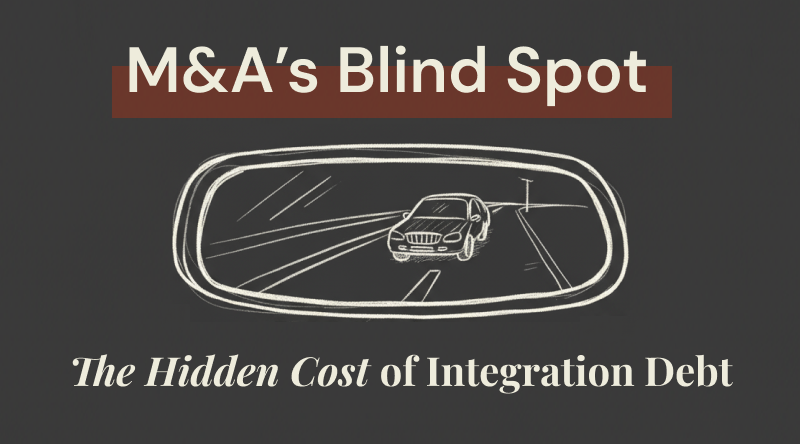
Integration Debt: The Unseen Liability
We call this integration debt, the compounding cost of forcing misaligned people, systems, and norms to "fit" after the close.
It's the organizational equivalent of technical debt in software. Each unresolved behavioral gap adds interest: slower decisions, rising attrition, and the quiet decay of trust.
The symptoms are easy to recognize:
- Strategic initiatives stall as leaders reinterpret the same goals differently.
- High performers leave, taking institutional knowledge with them.
- Workarounds multiply until the organization forgets what "aligned execution" looks like.
On paper, the deal succeeds. In practice, the enterprise becomes two companies occupying the same nameplate.
Quantifying the Hidden Cost
Integration debt is expensive, and measurable. Studies show that companies suffering post-merger disengagement experience up to 40% higher voluntary turnover within the first year. Each departure costs roughly 1.5 times salary in replacement and ramp time.
Delays in integration compound the loss: a six-month slip in synergy realization can erase 10-20% of projected deal value. By the time those costs surface in financial results, it's too late to correct them.
When Culture Becomes a Leading Indicator
Deals that treat culture as a due diligence discipline, not a post-close initiative, show markedly different outcomes.
In one global acquirer's portfolio, mergers that included Cultural Due Diligence (CDD) achieved integration milestones 18% faster and retained 25% more leadership talent through the first year. The reason wasn't better messaging or morale. It was foresight: identifying behavioral compatibility and friction before contracts were signed.
When culture is measured as behavioral alignment, it becomes predictive. Leaders can see, and mitigate, the human fault lines that otherwise emerge months later.
A New Standard of Diligence
Financial, legal, and operational reviews are non-negotiable. Yet behavioral diligence remains optional, treated as a "soft" variable despite being the hardest to repair.
That's changing. As data makes human fit measurable, forward-looking deal teams are beginning to model culture not as sentiment, but as execution risk. They recognize that the fastest way to destroy deal value is to assume that people will simply adapt.
Culture isn't soft. It's structural.
And in M&A, it is the single largest unmeasured variable in ROI protection.
Ignoring it doesn't make it go away, it just converts into integration debt that compounds until the deal pays interest no one budgeted for.
About the Authors
Eric and Simone are the co-founders behind HumanaQ, the AI-powered platform for Cultural Due Diligence and leadership alignment in M&A.