Key Takeaways
- 1.M&A used to be reactive, something companies did when a bank brought them an opportunity. It is becoming a deliberate, continuous tool to design what a company wants to become.
- 2.The shift shows up in four places: who leads the process, when integration thinking enters the deal, what is actually being bought, and how execution gets managed.
- 3.Design implies intention. The best acquirers now approach M&A as something they architect, not something that happens to them.
- 4.The human layer, whether the people involved can actually execute what has been designed, is the part most companies still leave to chance.
For most of M&A's history, the metaphor that fit was construction. You found a piece of land, you bought it, you built on it, and if the foundations were shaky you found out after the building went up.
The metaphor that fits now is design. Not because the deals got fancier, but because the best acquirers have started treating M&A less like a transaction they respond to and more like a tool they use deliberately.
That shift changes almost everything about how a deal process should run.
From reacting to a process to running one
Traditional M&A ran on the seller's clock. An investment bank ran an auction, set the timeline, and buyers competed reactively within whatever window they were given. The buyer showed up to a process someone else had already designed.
What's replacing that is what's being called Buyer-Led M&A: acquirers who build direct relationships with founders and CEOs years before a deal happens, control the pace of the process themselves, and start shaping the integration plan before a letter of intent is even signed. The difference isn't just who has leverage in a negotiation. It's who's actually doing the designing. A buyer showing up to someone else's auction is responding to a structure. A buyer who's spent two years in conversation with a founder, co-designing what the combined company should look like, is building one.
Closing the gap between deciding and doing
The old failure mode in M&A has a name most practitioners will recognize instantly: the knowledge chasm. Corporate development runs diligence, signs the deal, and throws the executed contracts over the wall to an integration team that was never in the room for any of it. The people who understood why the deal made sense are not the people responsible for making it work.
Integration-led diligence closes that gap by putting integration leads into the process before the LOI is signed. Not to check boxes, but to ask the operational questions that actually test whether the deal thesis holds up: can this organization absorb this change at this speed, do these two teams' ways of working actually fit together, what happens to the "secret sauce" if we do this the way we usually do it.
This is a design principle in the most literal sense. You don't discover whether a building will stand after you've built it. You test the load-bearing assumptions before you pour the foundation. Integration-led diligence is exactly that instinct applied to a deal.
Buying capability, not duplicate scale
For a long time, the logic of a deal was often simple: buy a competitor, eliminate the overlap, cut the combined cost base, and call the savings synergy. Useful when it worked. Also a fairly blunt instrument, more demolition than design.
What's replaced a large share of that activity is scope acquisition: buying a specific capability, a piece of IP, an AI technology, or a concentrated pocket of talent, specifically to enter an adjacent market the acquirer couldn't easily build its way into on its own. This is a meaningfully different kind of decision. Consolidation asks "how do we eliminate what's redundant." Scope acquisition asks "what does the future version of us need to have, and is buying it faster than building it."
That second question is a design question. It starts from a picture of where the company is going and works backward to what needs to be acquired to get there, rather than starting from what's available to buy and working forward to whatever synergies can be squeezed out of it.
Simulating the building before anyone commits capital
Here's where the metaphor stops being a metaphor and becomes almost literal. Acquirers are now building digital twins: dynamic virtual replicas of what the combined company would actually look like, paired with generative AI, to stress-test the post-merger reality before a single dollar of capital commits to it. Supply chain bottlenecks, projected cash flow under different integration paces, technology migration risk, even organizational churn, all modeled and pressure-tested in a virtual environment first.
That is design in the fullest sense of the word. An architect doesn't build a skyscraper and hope the wind load calculations were right. They model it first, in enough detail to catch the failure before it's expensive to fix. M&A is starting to work the same way, at least for the parts of the deal that are numerical enough to model.
Designing the org chart with the founder, not around them
In a Buyer-Led motion, the acquirer isn't imposing a pre-built playbook onto a target once the deal closes. They're sitting down with the founder before close and co-designing the actual charter: leadership roles, go-to-market structure, product roadmap, together.
And crucially, the resulting integration model isn't a single template stretched over every deal. It's chosen deliberately, based on what the specific deal actually needs. Leave the target standalone entirely, to protect a culture or a technical edge that would break under integration pressure. Integrate only the go-to-market motion while leaving engineering workflows untouched, to capture the revenue synergy without breaking the thing that makes the product good. Or run it in reverse: adopt the target's tools and processes across the combined company, because their way of doing it is simply better than the acquirer's.
That range of options is the clearest evidence that M&A has become a design discipline. A single integration playbook applied to every deal isn't design. It's a template. Choosing the right structure for this specific deal, this specific culture, this specific set of assumptions, is design.
The part of the blueprint most companies still leave blank
Here's the gap in this whole picture, and it's a significant one. Every element described above, buyer-led relationships, integration-led diligence, digital twins, adaptive integration models, is a way of designing the structural and operational architecture of a deal. What's frequently missing is a design specification for the humans who actually have to run the structure once it's built.
This is where behavioral data earns its place in the design process rather than sitting in it as an afterthought. Designing for human capital and cultural alignment means using behavioral evidence to structure the organization around what actually drives execution: discretionary effort, the gap between the minimum someone will do and the maximum they're capable of when genuinely engaged, and utility alignment, whether people will actually prioritize what the combined company needs over the narrower interests of their own patch.
Get this wrong and the beautifully designed integration model collapses anyway, not because the architecture was flawed, but because nobody designed for the specific people who had to inhabit it. A reverse integration model that assumes a target's team will happily adopt new authority structures is a design failure if that team's behavioral profile shows they'll quietly resist exactly that kind of change. A go-to-market-only integration that assumes sales territories will realign smoothly is a design failure if nobody checked whether the two commercial teams involved have any real basis for cooperating.
The architecture can be perfect. If the people inside it were never part of the design brief, it's still going to fail on the one input the blueprint didn't account for.
What "M&A as design tool" actually demands
If M&A is becoming a design discipline rather than a series of one-off transactions, the implication is straightforward: every dimension of a deal needs to be treated as something intentionally architected rather than something that happens to you.
That means the relationship with a target starts years before a deal, not at auction. It means integration thinking enters before the LOI, not after signing. It means the target profile is chosen against a picture of the future enterprise, not against whatever happens to be available. It means the operational model gets stress-tested before capital commits, not discovered afterward. It means the integration structure is chosen deliberately for this specific deal, not defaulted from a template. And it means the human capital layer, the actual behavioral capacity of the people who have to run all of it, is designed for with the same rigor as everything else, rather than left as the one part of the blueprint nobody filled in.
The acquirers treating M&A as architecture rather than transaction are the ones building companies deliberately. The ones still treating it as a reactive process are the ones discovering, after the fact, which parts of the building were never actually load-tested.
About the Author
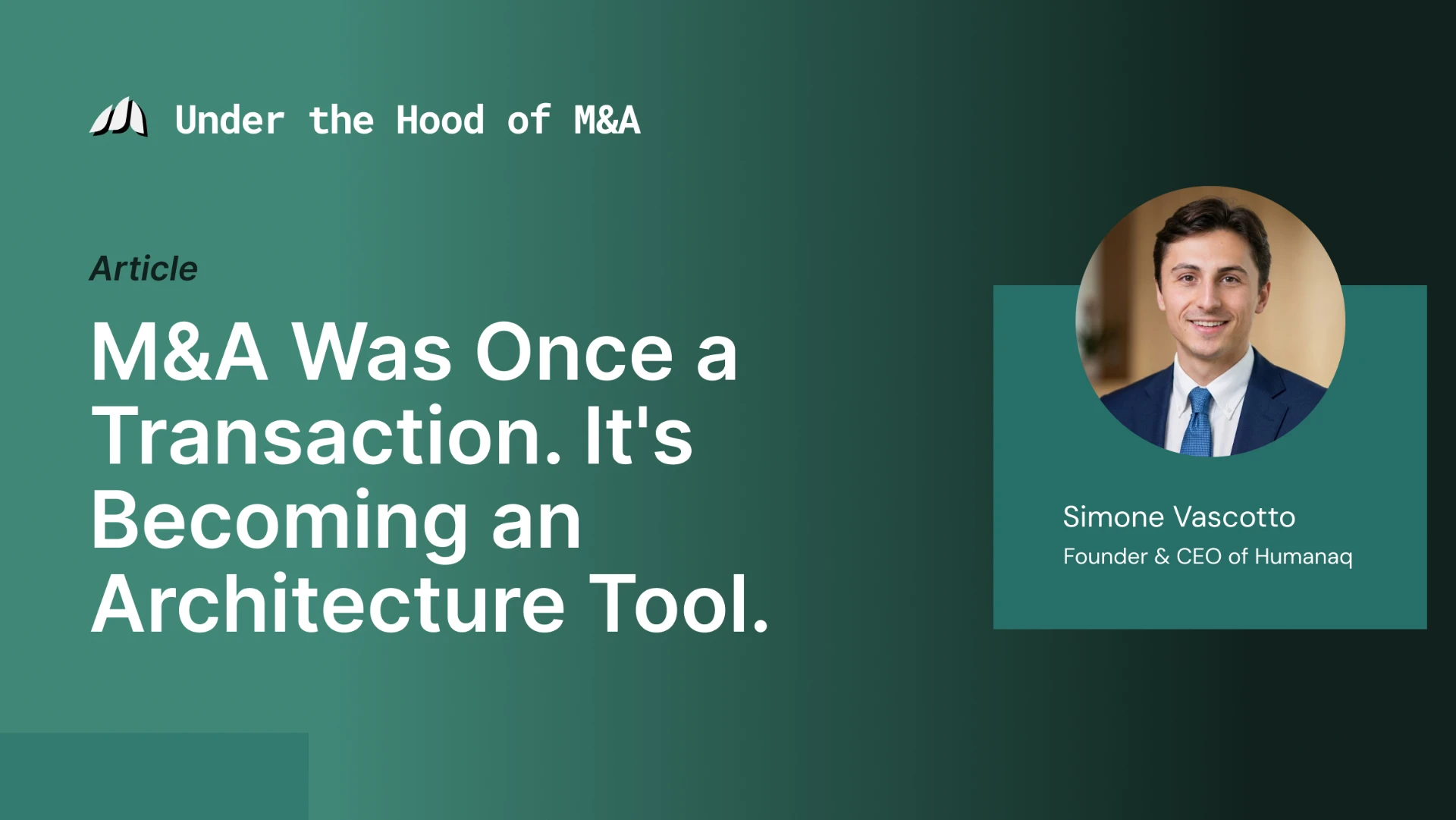
Simone Vascotto is the Founder of HumanaQ, the AI-powered platform for Cultural Due Diligence and leadership alignment in M&A.
Frequently Asked Questions
- What does 'M&A as architecture tool' mean?
- It means treating M&A as a deliberate design discipline rather than a reactive transaction. Acquirers build relationships, test operational assumptions, and choose integration structures intentionally before committing capital.
- What is buyer-led M&A?
- Buyer-led M&A is when an acquirer builds direct relationships with founders and CEOs years before a deal, controls the timeline, and co-designs the combined company rather than responding to a bank-run auction.
- What is integration-led diligence?
- Integration-led diligence puts integration leads into the deal process before the LOI to test whether the deal thesis actually holds operationally, rather than handing executed contracts to a separate integration team after signing.
- Why is the human layer the most commonly missed part of M&A design?
- Most design work focuses on structure, operations, and financial modeling. The behavioral capacity of the people who must run the new organization is often left as an unstated assumption, which is where execution risk actually lives.
- How does behavioral data fit into M&A design?
- Behavioral data measures whether the leadership team can execute the designed structure under pressure. It surfaces concentration risk, coordination gaps, and resistance patterns before the architecture is locked in.