Private equity M&A performance is polarized - and the gap is widening.
Programmatic acquirers with mature capabilities now generate 130% higher returns than non-acquirers (Bain 2024), with top performers achieving deal success rates above 70%. Meanwhile, the bottom three quartiles continue to struggle: only 14% of organizations achieve significant success across strategic, financial, and operational measures (PwC 2023).
This performance chasm persists despite 97% of PE firms incorporating AI into dealmaking (Deloitte 2025). The technology adoption paradox is stark - more firms are using AI than ever before, yet the capability gap between winners and losers continues to expand.
The differential stems not from financial modeling sophistication. Every sophisticated buyer now has access to similar capital structures and debt optimization. Instead, it stems from execution factors that financial models cannot capture, and that matter more than ever in today's PE landscape where 47% of value creation comes from operations - up from just 18% in the 1980s (PwC).
Two key execution dimensions separate winners from the rest:
Cultural integration capability: Can the people execute? Will key talent stay? Where will behavioral friction stall synergies? And critically - should we preserve a target company's culture, integrate it, or transform it?
Strategic orchestration discipline: Are we applying the right integration approach for this deal type? Do operational decisions align with strategic intent throughout the deal lifecycle? How do we translate boardroom vision into operational reality?
The firms mastering both are the ones achieving 130% outperformance. The question for PE operating partners isn't whether to use AI in M&A - it's which AI capabilities close the execution gap that separates programmatic acquirers from the rest.
The Dual Gap in Traditional Diligence
Traditional diligence frameworks excel at validating current-state financials and strategy. Financial models reveal projected cash flows, tax optimization opportunities, and debt capacity. But they don't answer the forward-looking questions that determine whether deals succeed or fail post-close.
Gap #1: The Cultural Intelligence Blind Spot
Traditional diligence validates what a company has done. It doesn't predict what a combined organization will do - or whether the people will execute when ownership changes and integration pressure mounts.
The cost of missing this dimension is staggering:
- 44% of integration failures stem from cultural misfit and friction (McKinsey 2023)
- 47-75% of key employees leave within one to three years post-acquisition (EY/MIT Sloan)
- Cultural integration issues destroy €1-5 million or more in value per transaction (Mercer)
In PE's operational value creation era - where nearly half of returns now come from operations versus less than one-fifth in the 1980s (PwC) - cultural execution capability directly determines IRR. Yet most acquirers still rely on executive interviews, employee surveys, and subjective impressions to assess culture. These methods introduce bias, require invasive processes during the confidential diligence phase, and fail to quantify behavioral compatibility in ways that inform valuation or integration planning.
The questions that matter most go unanswered: Where will decision-making bottlenecks stall execution? Does the management team have the cognitive patterns and leadership capabilities needed for the post-deal environment? Which teams show resilience under organizational stress, and which will fragment? How compatible are the behavioral patterns between acquirer and target – and where will that incompatibility create tangible costs?
Without quantifiable answers, firms arrive at Day 1 with generic integration plans disconnected from behavioral reality. The result: the 47-75% talent loss that undermines portfolio company performance and the cultural friction that consumes management bandwidth and delays synergy capture.
Gap #2: The Strategic Orchestration Blind Spot
Even when firms identify cultural risks and opportunities, they often lack frameworks to translate insights into appropriate action. This matters profoundly because the PE landscape has fundamentally shifted: 76% of buyouts are now add-ons (EY/Goodwin), where integration approach directly determines performance outcomes.
The data is stark: platform-integrated add-ons generate 35.5% average IRR while standalone approaches deliver just 23.1% (BCG), a 12-point differential worth millions in fund returns. Yet most teams lack frameworks for determining which approach matches which deal rationale.
The same cultural assessment demands radically different responses depending on strategic intent:
- Acquihire for engineering talent? Preserve the innovation culture, don't "integrate" it. Heavy-handed integration destroys the asset you paid a premium for.
- Transformation play for cost synergies? Drive systematic cultural change. Autonomy preserves the problems you acquired the company to fix.
- Market expansion as a standalone entity? Minimal integration, maximum autonomy. Over-integration creates friction without capturing relevant synergies.
Without adaptive frameworks connecting deal rationale to integration approach, even perfect cultural intelligence leads to strategic incoherence - where integration plans contradict acquisition objectives. Most M&A teams arrive at Day 1 with scattered insights across 8-10 different tools, multiple risk assessments from various platforms, and no unified framework to connect rationale to execution. At best the result is tactical efficiency without strategic coherence.
Applying AI-Enabled Solutions
The firms achieving 130% outperformance have discovered that competitive advantage lies not in deploying more AI tools, but in deploying AI that addresses both execution gaps simultaneously - measuring cultural dynamics AND orchestrating strategic coherence throughout the deal lifecycle.
This requires two distinct but interconnected AI capabilities:
Cultural Intelligence Through AI
Recent advances in natural language processing enable systematic analysis of behavioral patterns that traditional assessment methods miss. This is not sentiment analysis or culture surveys. This is cognitive and decision-pattern analysis - forward-looking behavioral prediction rather than retrospective cultural description.
What It Measures:
Modern AI-powered cultural assessment analyzes written responses, communication patterns, and linguistic structure to extract:
- Decision-making velocity patterns: Where will approval bottlenecks and bureaucratic friction stall execution speed?
- Leadership capability indicators: Does management possess the cognitive patterns and adaptability required for post-deal strategic shifts?
- Team cohesion and resilience markers: Which groups show the psychological safety and collaboration patterns that predict performance under integration stress?
- Behavioral compatibility scoring: Quantified cultural fit between acquirer and target across decision-making, communication, risk tolerance, and change adaptability dimensions
- Integration friction point mapping: Where will cultural differences create tangible costs, in delayed decisions, misaligned priorities, or talent departure?
How It Works:
From a scientifically designed set of open-ended questions administered to key stakeholders, AI systems extract cognitive and decision patterns, compare them across teams and against acquirer benchmarks, and generate compatibility scores. The process avoids the invasiveness of traditional cultural due diligence methods while eliminating the bias inherent in surveys and interviews.
The system identifies execution bottlenecks before they materialize, predicts where synergy realization may stall or accelerate based on behavioral patterns, and quantifies cultural integration risk in financial terms, enabling teams to price cultural friction into their valuations or walk away from deals where behavioral incompatibility would destroy projected value.
The Impact:
PE firms using AI-based behavioral assessment report 30-40% lower integration costs and 25% faster synergy capture compared to traditional approaches. More importantly, they avoid the 47-75% talent loss that undermines most acquisitions - because they identify retention risks and cultural friction points before the deal closes, not after key employees have already resigned and institutional knowledge has walked out the door.
In the add-on-dominated PE landscape - where 76% of deals require integration decisions - this capability directly addresses the human factors that determine whether firms capture 35.5% IRR or settle for 23.1%.
HumanaQ's platform enables this cultural intelligence at scale, transforming "soft" culture concerns into measurable, actionable deal variables that inform valuation, shape integration planning, and predict execution probability with quantifiable precision.
Strategic Orchestration Through AI
Cultural intelligence reveals execution probability and behavioral friction points. But strategic frameworks determine what should be executed, when integration should occur, and how to maintain coherence between deal rationale and operational decisions throughout the transaction lifecycle.
What It Provides:
Strategic orchestration frameworks powered by AI deliver:
- Deal rationale translation: Systematic conversion of board-level strategic intent into operational priorities, success metrics, and integration guardrails
- Integration scenario mapping: Matching specific deal types and value drivers to appropriate integration approaches - preservation, selective integration, or transformation
- Dynamic scope generation: Automated creation of deal-specific due diligence checklists, integration workstreams, and Day 1 priorities that flex based on strategic configuration
- Decision anchoring throughout lifecycle: Ensuring tactical choices during diligence, negotiation, and integration remain aligned with the strategic rationale that justified the acquisition
- Adaptive frameworks: AI recommendations that adjust based on deal type, value drivers, risk factors, cultural assessment findings, and client-specific operational models
How It Works:
By establishing a "Deal NorthStar" - combining deal type classification, integration scenario selection, primary value drivers, and risks-to-value identification - AI-powered strategic frameworks generate optimized due diligence priorities, baseline integration deliverables tailored to strategic context, and deal-specific performance metrics.
The system maintains strategic coherence while allowing tactical flexibility. If cultural assessment reveals strong product innovation culture, the strategic framework determines whether that culture should be preserved (in an acquihire scenario), partially integrated (in selective integration), or transformed (in cost synergy play) - ensuring cultural intelligence drives strategic action rather than generating reports that sit unused.
The Impact:
Organizations deploying strategic orchestration frameworks are 1.9x more likely to have the right capabilities and talent to execute M&A strategy, and 1.6x more likely to design integrated organizational structures effectively (McKinsey). They achieve the systematic deal execution that separates programmatic acquirers from episodic dealmakers.
This directly addresses the 12-point IRR gap between platform-integrated and standalone add-on approaches (BCG). Tiger Team M&A's M&AOP platform pioneers this orchestration layer, ensuring cultural insights, due diligence findings, and integration plans remain anchored to strategic intent across the 76% of PE deals that are now add-ons requiring nuanced integration decisions.
Conclusion
The private equity advantage is shifting. For three decades, outperformance came from financial sophistication - better capital structures, tax optimization, debt management. That advantage has largely commoditized. Every sophisticated buyer now has access to similar financial engineering capabilities.
The next advantage lies in operational orchestration - specifically, the ability to:
- Quantify what financial models miss: The behavioral patterns, cultural dynamics, and human capital factors that determine whether strategies get executed or stall in bureaucratic friction and talent loss
- Interpret what diligence identifies: Translate cultural insights and strategic rationale into coherent, adaptive integration approaches that match deal-specific contexts rather than applying generic playbooks
Neither capability alone is sufficient. Cultural assessment without a strategic framework generates insights but not action plans. Strategic frameworks without cultural intelligence design plans that ignore behavioral reality. Both failures lead to the same outcome: the 86% of deals that fail to achieve significant success.
In private equity's current landscape, where add-ons dominate deal flow, operational value creation drives returns, and talent determines execution capability - the firms mastering cultural intelligence and strategic orchestration will capture the IRR premiums that separate winners from the rest.
About the Authors
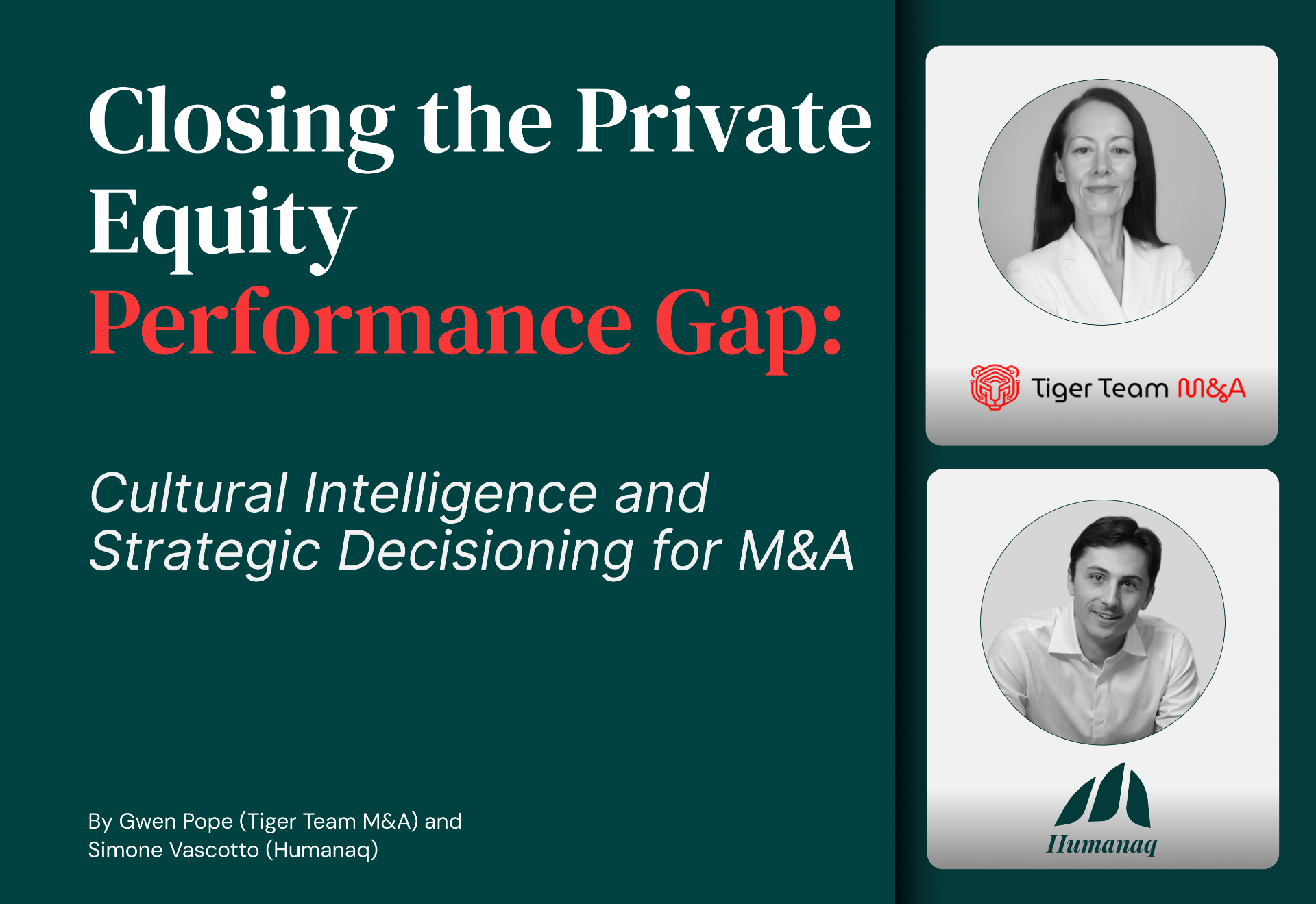
Gwen Pope is founder and CEO of Tiger Team M&A, and veteran M&A leader with two decades in Fortune 500 M&A. Tiger Team M&A delivers the first agentic platform for strategic decisioning in M&A, enabling serial acquirers to drive growth through M&A excellence. Their clients transform M&A from episodic transactions into systematic, scalable value creation.
Simone Vascotto is founder of HumanaQ, where he pioneers AI-powered cultural due diligence solutions that enable private equity firms and strategic acquirers to measure and predict organizational compatibility, behavioral friction, and execution probability before deals close. HumanaQ's platform transforms cultural assessment from subjective evaluation to quantifiable deal variable.