Key Takeaways
- 1.The handover problem starts during diligence, not after signing.
- 2.Integration teams need a mandate and a shared language of value to be heard by deal teams.
- 3.Physical proximity and rotation programs build continuity between deal and integration people.
- 4.Deal team incentives should include value realization, not just completion.
- 5.Behavioral and execution intelligence must travel with the deal thesis, or the integration team starts blind.
The cost of the disconnect
Most deals are run by two teams that barely overlap. The deal team builds the thesis, negotiates the price, and completes the transaction; the integration team is expected to deliver what was promised. In practice, the cohesion between them is weaker than most acquirers would admit, including large, experienced buyers.
The cost starts earlier than most people think. When an integration person is not in the room during the deal, PMI challenges (and there will be many) never reach the negotiation with the seller, and with them goes the chance to reflect real integration complexity in the purchase price. The end-state view typically stays vague, so the synergy case rests on assumptions that may not survive contact with operating reality.
The integration team starts weeks behind, rediscovering what the deal team already knew about the target: its people, its politics, its real dependencies. Day-1 priorities get set without the context that shaped the deal. Retention conversations that should have happened before signing happen after resignations instead. The list goes on, and so do the costs.
What the acquirers who fixed this actually did
Many experienced acquirers have learned these lessons, though, surprising as it is, not all of them, and adjusted the way their deal and integration teams work together. Most learned it the hard way, which is exactly what makes their experience worth studying for up-and-coming buyers, corporate or PE-backed.
- Bring integration in during diligence, not after signing. Not as observers, with a mandate: testing the synergy case against operating reality while the deal can still be shaped. Two things change. The purchase price can reflect real integration economics while there is still a negotiation to have them in. And the integration plan starts from the deal logic and the "right from the oven" inputs of DD (financial, people, product, regulatory, etc.) instead of being reverse engineered from the purchase agreement afterwards. The firms that manage this handover most effectively do not treat diligence and integration as sequential phases. They treat them as a continuous process where insights gathered during diligence actively shape integration design.
- Make the two teams speak the same language, and that language is money. Deal teams are numerical; integration teams often tend to come from the communications, stakeholder, process, and change side. When the integration lead says "cultural misalignment risk", the deal team hears fluffy noise. When they say "if we harmonise terms in year one, expect attrition in the engineering team we priced the deal on, here is the replacement cost and the roadmap delay", the deal team hears a number. Integration people who can express PMI issues in value terms get invited into deal conversations; those who can't get briefed after signing.
- Put them in the same room, literally. Some of the more successful serial acquirers we've seen do something unglamorous: corp dev and the integration team share office space. No process fixes what daily physical proximity fixes, deal context travels in real time. One large industrial manufacturer, an international brand and a serial acquirer, made it structural: junior deal team members rotate into the integration team, and integration people temporarily join live deal teams. The benefit goes both ways. Deal-side people who have sat in an integration steerco price their next deal differently. Integration people who have been inside a live deal know why the numbers look the way they do and which ones were fought over. Within a few deal cycles, the two teams stop being two cultures, and the formal handover matters less, because half the context has already travelled with the people.
- Pay the deal team for value, not completion. If the M&A team's KPIs stop at deal completion, everything beyond is fighting the incentive structure, which usually is an uphill battle. Complement completion metrics with value indicators that mature over 12-24 months: synergy realisation against the case underwritten, retention of the people named as key in DD, integration cost against budget. Even a modest share of variable compensation tied to these changes behaviour, because it changes what the deal team writes down. Nobody hands over a vague synergy case they'll be measured against later.
The cost of not fixing it
The numbers back this up. In McKinsey's 2023 survey of over a thousand M&A leaders, lack of cultural fit and friction between acquirer and target ranked among the most-cited reasons integrations fail. EY research puts key-employee attrition at close to half within the first year post-acquisition, and up to three quarters within three years. And a large share of value creation plans fail to take root not because the financial model was wrong, but because the execution conditions required to deliver them were never adequately understood or communicated. These are not integration failures in the narrow sense, but rather handover failures. The intelligence that would have enabled the integration team to manage these risks was either never generated or never transferred in a usable form.
So what?
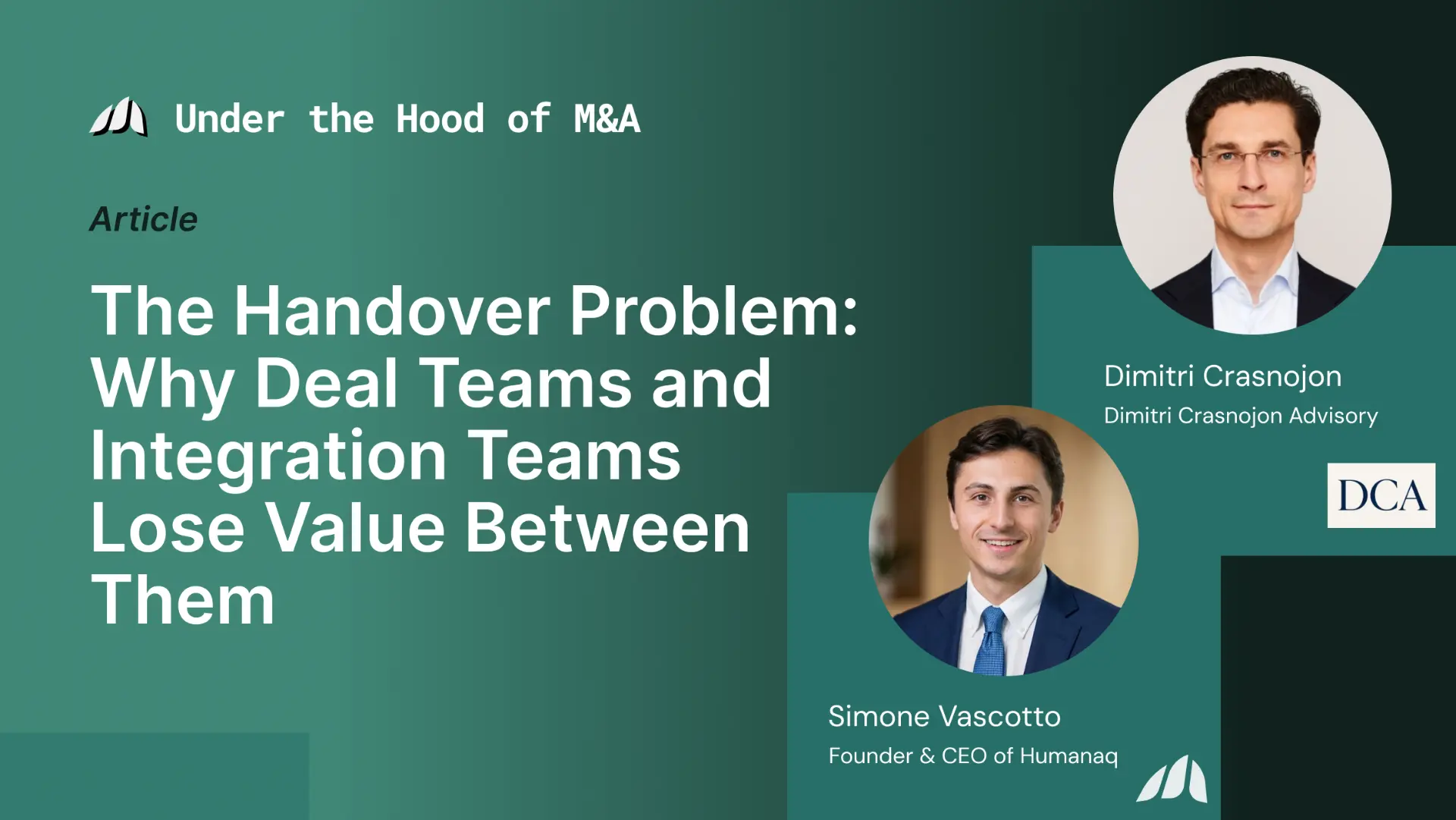
The handover problem will not be solved by better integration teams. Integration teams can only work with what they receive. It will be solved when there is no practical handover, even though a formal one is a must from an accountability standpoint, as to who drives the deal execution after Day-1. And this can only happen when the deal team and integration team are in sync and work closely together from the course of DD onwards. Get that right, and the integration team spends its first hundred days managing the deal thesis rather than discovering it no longer applies.
This conversation is part of the AI in M&A series running through the Under the Hood of M&A newsletter.