Key Takeaways
- 1.AI tools in M&A are fast but lack deal thesis context, producing generic analysis instead of deal-specific intelligence.
- 2.The gap between diligence findings and the original deal rationale is where execution risk compounds.
- 3.The messy middle, between Day 100 and the target operating model, is where most deals lose momentum.
- 4.Outcome data in M&A takes years. Be skeptical of any platform claiming definitive results in its first year.
- 5.The commercial challenge for AI in M&A is not the technology. It is translating operational pain into financial language for budget holders.
This is part of a series where I sit down with founders building or using AI tools for M&A, uncovering what's working, what's not, and where AI in M&A is heading.
Building an AI platform in this industry means I talk to other founders building tools and see what practitioners are actually using in live deals. These breakdowns share those conversations. If something resonates, I'd appreciate you passing it along to someone on your team.
After more than a year of building AI tools in M&A, one theme keeps surfacing in every conversation: the gap between what AI can process and what it actually understands.
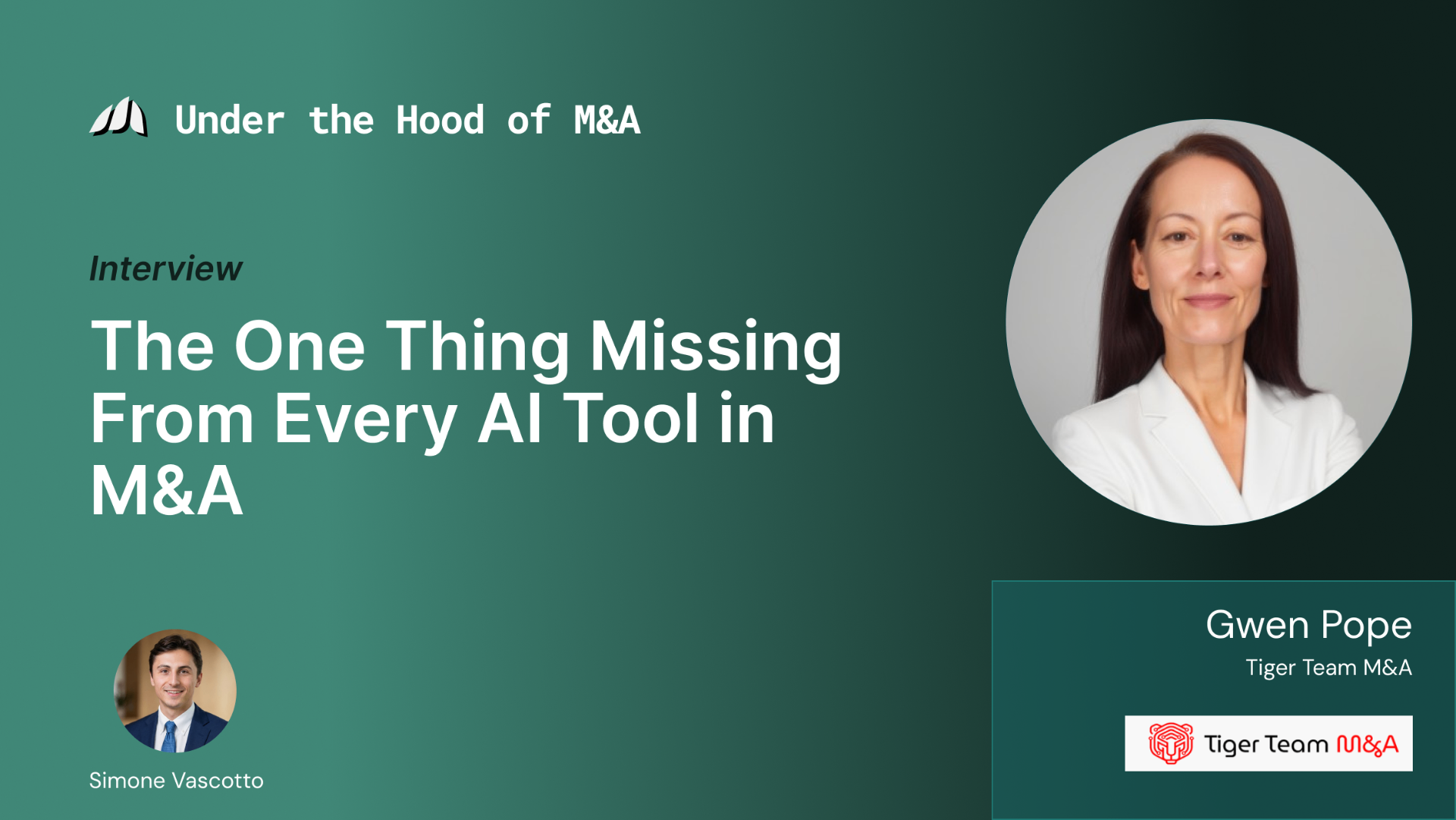
As the first piece of this series, I was able to speak with Gwen. Gwen spent close to two decades inside M&A at Google and Microsoft, not advising on deals, but running them. Building the operational frameworks that made acquisitions land. When she left to co-found Tiger Team M&A about a year ago, she was solving a problem she'd watched compound across hundreds of deals.
The problem wasn't information. It was connection.
Here's what I took away:
1. The Deal Thesis Gets Written. Then It Gets Abandoned.
Gwen describes the pressure cooker of a live deal, the thesis gets documented, diligence gets done, and then somewhere between LOI and integration, the thread snaps. What you're left with is a team making judgment calls in isolation, without a clear line back to why the deal was being done in the first place.
"Even if you have the best, perfect in theory deal rationale, a huge 60-page document, it probably is like academic theory. Essentially. If you don't then work to make sure that your diligence is focused based on whatever it is you're doing the deal for."
I've heard versions of this from nearly every practitioner I've talked to. The thesis exists. The diligence exists. The connection between the two often doesn't.
What makes it a real operational problem is that a finding in diligence can mean completely different things depending on what the acquirer is actually trying to do with the business. Without that context, risk flags get treated generically. Decisions get made in the dark.
2. "The Data Room Doesn't Know Why You're Doing the Deal"
AI has genuinely transformed the top of the deal funnel. Target identification, document review, financial modeling, the tools are real and the time savings are real. But ask an AI-enabled data room which open items actually matter with two weeks left in diligence, and it has nothing.
Not because the technology is insufficient. Because it doesn't know why you're doing the deal.
That context gap is what Tiger Team M&A was built around. Gwen and her colleagues built a platform that anchors every diligence finding, every integration assumption, and every agent recommendation back to the original deal rationale, not as a document that gets filed after the strategy meeting, but as a live reference point that the whole process is tested against.
"It's about being able to approach a deal holistically. Starting upstream, setting this anchor point. Here's why we're doing the deal."
The distinction she draws between speed and context is worth noting. Speed without context produces faster versions of the same generic analysis. Context without speed is consulting. The combination, fast outputs anchored to the specific deal, is what deal teams actually need. Very few platforms are built to provide it right now.
3. The Messy Middle Is Where Deals Actually Break
Nearly all AI tools built for M&A are concentrated on the left side of the deal lifecycle, competitive research, target sourcing, and diligence. Gwen's focus, and the company she founded, is different. Full lifecycle, and relentlessly through a value creation lens.
The stage she keeps returning to is the window between Day 100 and the target operating model, what she calls the messy middle. Even deals that clear diligence with real solidity, with a preliminary integration plan in place, often lose their footing here.
"You kick off Day 1, proceed to onboard teams, and they sort of land. But then over there is the end state that you envision. How do you get there?"
That question is the product. Not the thesis. Not the end state. The navigation between them.
4. Outcome Data Takes Time. Be Skeptical of Anyone Who Claims Otherwise.
I asked the obvious question: is Tiger Team M&A producing measurable improvements in deal outcomes?
"I think it's too early. The short answer."
That's the honest answer, and it matters. The tail of a deal is long. Synergy realization plays out over years. Culture and talent retention only become visible 18 months post-close. Any platform claiming definitive outcome data in its first year should be asked exactly what it's measuring.
"There's a longer tail that tells the story of the value creation and the synergies. And it's also hard to simply quantify over time. But once you do, I think those will be the industry-leading numbers."
5. The Commercial Problem Isn't the Technology. It's the Translation.
Gwen's experience bringing Tiger Team M&A to market resonated immediately, because it's exactly what we're navigating as well.
In almost every organization evaluating a new M&A tool, there are two distinct audiences. The practitioners who feel the operational pain every day, deal leads, integration managers, M&A directors who live inside the problem. And the stakeholders who experience M&A as an outcome, not a process, the CFO, the corp dev head, the board member asking why synergies are tracking below model.
"There's a set of folks, the direct M&A teams and M&A leaders, that are directly under the pressures and feeling the pain points. And then there's all the other stakeholders. Meaning the leadership that's just aware of the outcome."
These two audiences need completely different conversations. The practitioner needs to understand what changes operationally. The budget holder needs to understand what changes financially. Getting both right, in the right sequence, with the right framing, that's the actual commercial challenge. Not the technology. The translation.
Final Thoughts
The 70% deal failure statistic has been cited long enough. What makes it worth repeating is that it hasn't moved, despite two decades of better financial models, better legal diligence, and better data rooms.
The layer those improvements haven't touched is execution. That's where the 70% lives.
What Gwen is building at Tiger Team M&A isn't trying to replace deal judgment. The human element in M&A isn't a legacy constraint to be engineered around, it's the whole point. What AI can do is give the person making the decision a better information base to make it from.
"Seeing teams be able to raise the bar, focusing more and more of their time on strategic considerations rather than chasing down the source of truth for a rationale or burning cycles on ad hoc workflows. That's probably the leg up all of us needed."
The tools to break that statistic are available now in a way they weren't five years ago. The practitioners who have the most to gain are the ones who already understand why it keeps going wrong.
Frequently Asked Questions
- What is the biggest gap in current AI tools for M&A?
- The connection between workstreams. Most AI tools are point solutions that do one task well at one stage. The strategic thread tying sourcing to diligence to integration is still held together by human memory, not by a system designed to maintain it.
- What is deal thesis continuity?
- Deal thesis continuity is the discipline of carrying the original investment rationale through every workstream, so diligence findings, integration plans, and value creation initiatives all trace back to the assumptions they validate or contradict.