Key Takeaways
- 1.By the time integration issues appear in financial data, they have been forming for weeks. Behavioral signals precede financial signals.
- 2.The first 30 days establish a behavioral baseline. Without it, the integration team manages by feel rather than data.
- 3.The Day 30 truth check compares baseline against patterns under pressure, surfacing which assumptions are holding before EBITDA confirms it.
- 4.Sequencing change around behavioral resilience outperforms aggressive parallel workstreams in deals with low organizational adaptability.
- 5.AI changes the information architecture of the first 100 days without changing the judgment required. Decisions still belong to the integration lead.
Short answer
The first 100 days after an acquisition are where deals quietly succeed or become unrecoverable. Not because the strategy changes, but because execution finally becomes real. By the time integration issues show up in the numbers, they have already been forming for weeks, usually inside the first 30 days. AI is now making this visible before it becomes financial damage. The advantage is not better planning. It is earlier visibility into how execution is actually unfolding while there is still time to change it.
The first 100 days are different
Day 1 is not the finish line. It is the first real moment the seller's team starts testing what the acquisition actually means in practice, not in a deck. Everything before close is negotiation, analysis, and planning. Everything after close is execution.
The deal team spent months building a model based on reasonable assumptions: leadership continuity, deal value delivery, smooth integration. Those assumptions are often directionally right. What those models rarely account for is how differently teams interpret the same direction once pressure is applied. The first 100 days is when that gap shows up.
What is often missed is that these assumptions are not tested in a vacuum. They are tested through how people interpret direction, set priorities, and make decisions when things get hard. That layer is far less visible. And far more decisive.
The deals that deliver do so because the acquirer arrived at Day 1 with a clear read on how the organization would actually operate. The deals that do not almost always trace failure back to decisions that were made too late, or not made at all, during this window.
What separates the deals that work from the ones that don't
What makes this dangerous is not that assumptions get tested. That is expected. It is that most teams do not have visibility into how those assumptions are breaking down in real time. Instead, they rely on updates, meetings, and KPIs that lag what is actually happening underneath: how people are interpreting direction, where priorities are colliding, and where ownership is unclear. By the time those issues surface clearly, the cost is already locked in.
The acquirers who navigate this window well do not just move faster, they reduce uncertainty earlier.
They focus on three things immediately:
- Where execution risk is most likely to concentrate (by team and operating level)
- How consistently direction is being interpreted across those groups
- Whether decisions and ownership are actually holding under pressure
This gives them something most teams lack in the first 100 days: a clear, early read on where execution is forming and where it is likely to break.
The core insight is this: behavioral signals precede financial signals in any organizational system under stress. This is what AI-powered behavioral analysis is now capable of solving.
AI tools that measure organizational behavior at this level, through analysis of natural language patterns, decision-making sequences, and communication structures, can surface these signals at Day 30 rather than Day 90. That 60-day lead time is not a marginal improvement. It is the difference between an intervention that works and a discovery that comes too late.
What AI makes possible at each stage of the first 100 days
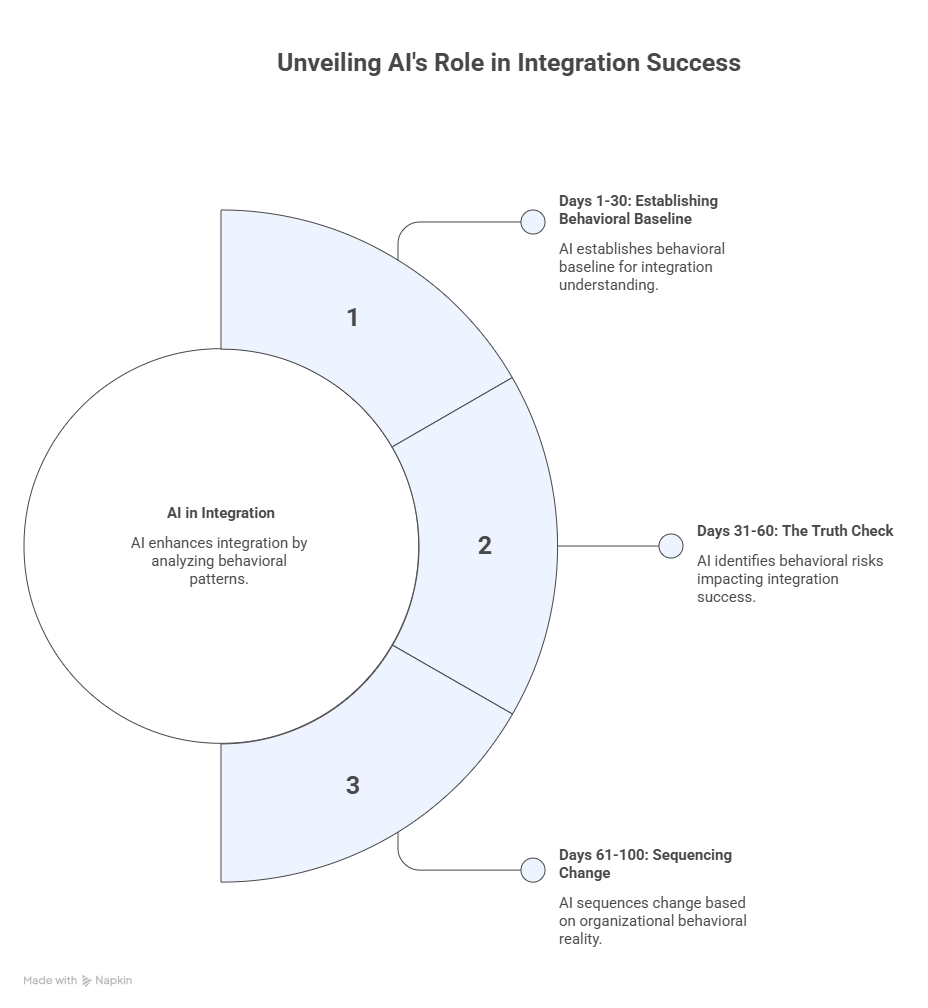
Days 1 to 30: establishing the behavioral baseline
The most important thing AI can do in the first 30 days is not analyze documents or track milestones. It is establish an execution read on the acquired organization before the integration pressure changes it.
AI-powered language analysis applied to the natural communication patterns of the acquired leadership team produces a behavioral baseline that tells the integration lead things no onboarding process surfaces: how this leadership team actually makes decisions, where their risk tolerance sits relative to the integration demands being placed on them, which individuals are behaviorally positioned to absorb change and which are not.
This baseline is the reference point that makes everything that follows measurable rather than impressionistic. Without it, the integration team is managing by feel. With it, they are managing against data.
Days 31 to 60: the truth check
The Day 30 truth check is where AI delivers its most commercially significant value in the first 100 days.
By comparing the behavioral baseline established in the first 30 days against the patterns emerging under actual integration pressure, AI can tell the integration lead which assumptions are holding and which are breaking down before any financial metric confirms either. A collaboration pattern between two synergy-dependent functions that is deteriorating at Day 30 is a warning the EBITDA data will not carry until Day 90. A resilience profile that is declining across the acquired leadership team is a signal that performance softening is coming before it arrives.
This is the intervention window. It is specific, it is time-limited, and it only exists because AI has made the behavioral layer visible early enough to act on.
The practical output of this truth check is a prioritized list of the three to five behavioral risks most likely to affect the integration thesis in the next 30 days, each expressed in terms of what it means for a specific synergy assumption or timeline milestone. Not a cultural observation. A financial warning with a window to respond.
Days 61 to 100: sequencing change around behavioral reality
The instinct in a compressed integration is to run workstreams in parallel and push change through simultaneously. For organizations with low behavioral resilience or low adaptability, this instinct is expensive.
AI that has been tracking the behavioral patterns of the acquired organization across the first 60 days knows which cohorts are absorbing change well and which are not. It can sequence governance introductions, synergy workstream launches, and leadership interventions around the behavioral reality of what the organization can actually absorb rather than the timeline the integration plan assumed.
The deals that execute well in the first 100 days are not the ones with the most aggressive integration schedules. They are the ones with the most accurate read on what the organization can sustain, moving at the pace that reality supports rather than the pace the model projected.
What this changes about integration management
For most of M&A history, the first 100 days have been managed through a combination of experience, instinct, and lagging operational data. AI changes the information architecture of the first 100 days without changing the judgment required to act on it. The experienced integration lead still makes the calls. The operating partner still decides where to focus management attention. The deal partner still determines whether the integration is tracking toward the return the IC approved.
What changes is that these decisions are now being made with behavioral intelligence that leads the financial data rather than lagging it. The question is no longer "what does the financial data tell us happened?" It is "what does the behavioral data tell us is forming?"
Closing thought
The first 100 days do not define success because they are busy. They define success because they lock in how the organization will execute under pressure.
Most teams do not realize how much of that outcome is already set in motion early on, because they cannot see it yet. The behavioral layer that determines whether people follow through on commitments, absorb disruption without destabilizing, and execute direction consistently under pressure is forming from Day 1.
AI is now making that layer visible in real time, at the speed integration decisions require, and in a format that connects behavioral patterns directly to the financial assumptions they are either supporting or undermining.
The advantage is not better planning. It is earlier visibility into how execution is actually unfolding while there is still time to change it.