Integrations rarely fail because leaders lack insight. They fail because alignment is assumed to survive contact with execution.
Across transformations, integrations, and strategic initiatives, leadership teams often reach strong agreement on goals, priorities, and direction. Workshops are held. Decisions are documented. Alignment appears real. Yet coordinated execution still breaks down.
This failure is not caused by bad intent or insufficient awareness. It occurs when execution communication is assumed rather than deliberately designed.
The Alignment Illusion
Shared understanding is frequently mistaken for operational alignment.
When leaders agree in principle, on strategy, outcomes, or urgency, it creates the impression that alignment will naturally persist as work cascades through the organization. In reality, agreement at the top almost never guarantees consistency in execution.
Alignment begins to erode in the space between:
- what leaders mean
- what teams interpret
- what behaviors are actually reinforced
This gap is rarely visible in planning sessions. It only becomes apparent once execution is underway.
Where Alignment Breaks (or is never established)
Breakdowns typically occur in three predictable ways.
First, decision ownership is never codified. Teams may agree on objectives, but lack clarity on who decides, who executes, and who resolves conflict when trade-offs emerge. When decision rights are implicit rather than explicit, execution slows and workarounds and rework begins.
Second, work priorities compete without visibility or adjustment. Even when strategic goals are aligned, contributors interpret urgency differently. Without clear sequencing and escalation paths, individuals optimize locally, assuming others are aligned, until friction surfaces.
Third, communication shifts from explicit to assumed. Early in an initiative, leaders communicate frequently and deliberately. Over time, communication becomes implicit. Expectations are no longer reinforced, and alignment is presumed to hold. This is where divergence accelerates.
In each case, alignment does not disappear suddenly. It may never have been established in the first place.
Awareness Is Not Execution Readiness
Awareness is necessary, but insufficient.
Understanding a strategy does not ensure consistent execution under pressure. Execution depends on reinforcing communication structures, not shared intent alone. When alignment relies on memory, goodwill, or informal consensus, it becomes fragile. Under uncertainty, stress, or speed, teams revert to default behaviors rather than stated agreements.
This is why execution failures often surprise leadership. From their perspective, alignment was achieved. From the initiative's perspective, it was never fully operationalized.
Designing for Alignment, Not Assuming It
Closing the alignment gap requires treating execution communication as a design problem.
Effective organizations do not rely on alignment to persist organically. They reinforce it through explicit decision frameworks:
- visible ownership and accountability
- structured feedback loops
- clear escalation mechanisms
These structures do not constrain execution. They protect it.
By making alignment observable and self-correcting, organizations reduce reliance on interpretation and minimize execution drift.
From Agreement to Action
Alignment is not a state to be achieved once. It is a condition that must be continuously supported by structure.
Organizations that consistently avoid execution breakdowns treat alignment as something to be measured and engineered. By measuring behavioral alignment early and planning integration structures around those realities, organizations reduce uncertainty at the moment it matters most. Instead of discovering misalignment during execution, they design for it in advance.
Organizations that recognize and take steps to mitigate these behaviors prevent execution breakdowns before they become costly. Those that do not often discover misalignment only after momentum slows, confidence erodes, frustration and cost increase, and value begins to leak.
About the Authors
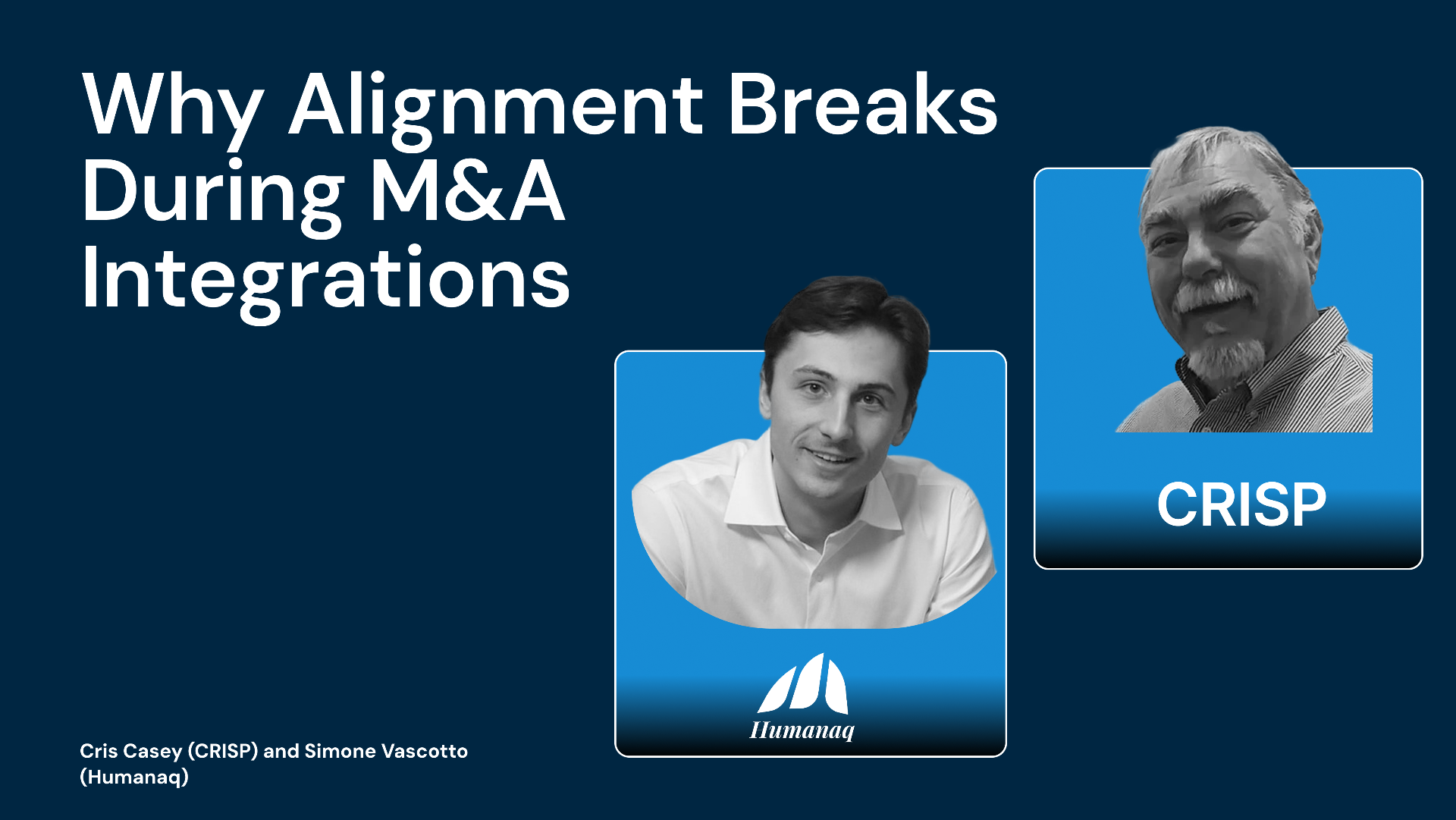
Simone Vascotto is founder of HumanaQ, pioneering AI-powered cultural due diligence solutions that enable private equity firms and strategic acquirers to measure and predict organizational compatibility before deals close.
Cris Casey is an experienced organizational leader specializing in strategic alignment and execution frameworks for complex transformations.