Key Takeaways
- 1.70 to 90 percent of acquisitions fail to reach their strategic or financial objectives, and the root cause is almost always the people.
- 2.Invisible culture, how decisions actually get made, unwritten rules, informal hierarchies, is where the real integration risk hides.
- 3.Behavioral analytics measures execution patterns rather than emotions, delivering a quantifiable risk score in days rather than months.
- 4.Identifying champions and resistors pre-close lets acquirers design integration around the people who will accelerate or block change.
- 5.AI-powered behavioral assessment now makes cultural due diligence accessible for deals as small as €5M, not just large-cap transactions.
- 6.The number one mistake acquirers make is assuming, assuming the acquired team will adopt new systems, follow new rules, and align with the new vision without structured communication.
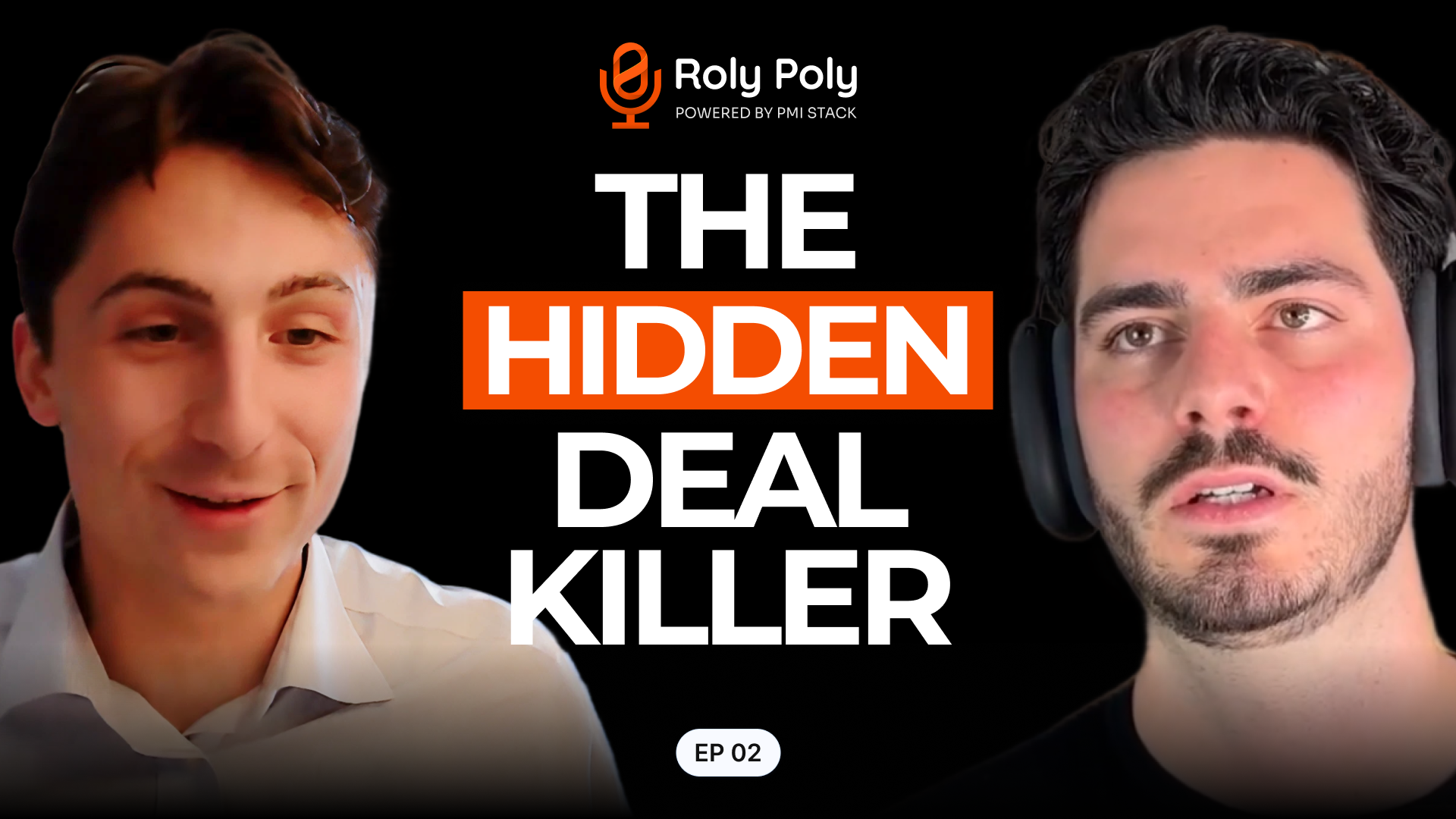
This article is based on an interview on the Roly Poly podcast (powered by PMI Stack) with Dylan Harrocks, Episode 02: "The Hidden Deal Killer."
The Hidden Cost of Cultural Mismatch
One stat keeps coming up in nearly every conversation with roll-ups and PE-backed buyers: 70 to 90 percent of acquisitions fail to reach their strategic or financial objectives.
That's staggering. And when you ask where the failures come from, the answer is almost always the same: the people.
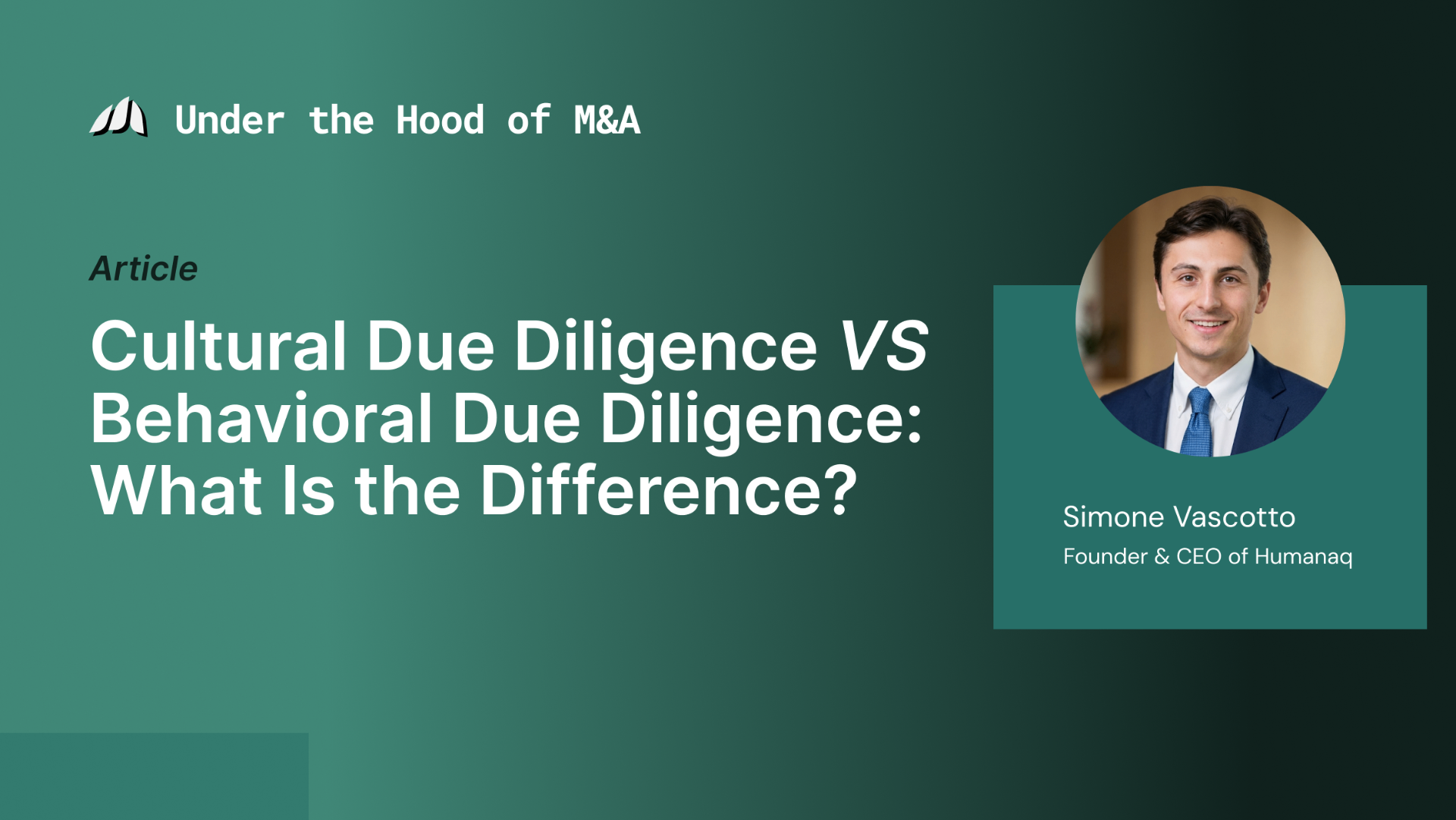
This was the thrust of a recent conversation with Simone Vascotto, founder of HumanaQ. He's built an AI-powered behavioral assessment tool for cultural due diligence, essentially a systematic way to measure cultural risk before a deal closes. It sounds niche. But once you understand what he's actually solving for, you realise it might be the most overlooked piece of acquisition strategy.
Here's the problem: Most acquirers are still operating with a 20th-century playbook.
How M&A Changed (But Our Playbooks Didn't)
A hundred years ago, acquisitions were simple. A railroad company bought another railroad company. Their processes were similar, their business models were similar, their culture was probably similar. The deal was mostly about pricing power and market control.
Now? Corporate buyers are acquiring startups. Search funds are buying legacy businesses. Private equity is consolidating fragmented industries where every company has a different operating system, sometimes literally different software stacks, but more importantly, different ways of working.
"At the beginning, M&A was to get pricing power. You'd see acquisitions primarily with really big players. But you knew plus or minus what the business model was. Now we're moving into deals where AI, different processes, different systems, people, culture, all these things that weren't necessary before, are now necessary to reach your objective."
The consequence? The model of how M&A is done hasn't evolved to match the complexity of the deals being done.
Investment banks still move quickly. Due diligence still focuses on financials and technology stacks. But the place where most deals actually fail, the alignment of the people doing the work, often doesn't get systematic attention until after close.
Visible Culture vs. Invisible Culture: Where the Real Risk Hides
Everyone talks about culture. You see it in mission statements, values posters, and strategy decks. That's visible culture, the stuff you see communicated explicitly.
But there's another layer. The invisible culture is:
- How decisions actually get made (not how the org chart says they should be made)
- Unwritten rules that people follow subconsciously
- The way things really work, as opposed to the way they're documented
- Informal hierarchies and norms that evolved over time
Two companies both described themselves as "entrepreneurial." On paper, they looked aligned. But when you looked closer, one's definition of entrepreneurial meant "fast execution with minimal process," while the other meant "thoughtful experimentation and R&D investment."
Same word. Completely different meaning. Completely different way of actually working.
When you acquire one and try to integrate it under the other's culture, that invisible gap becomes an invisible friction point. People get frustrated. The acquired team feels like they're being forced into a mold that doesn't fit their actual values. Integration stalls.
"The real culture is the invisible. That is how decisions are made. It's where the decisions are made. It's all about the people. It's the things that are between the lines that are not written."
This is why behavioral due diligence matters. You can't measure culture by asking people to agree with a values statement. You have to measure how they actually behave, and what their behaviors reveal about how the organization really works.
From Emotions to Execution: Why Behavioral Beats Surveys
Traditional cultural due diligence is what you'd get from McKinsey or the Big Four: interviews and surveys. They measure emotion. Personality tests. Likert scales. How people feel about the culture.
The problem? Emotion is volatile. It fluctuates. And it doesn't directly tell you about execution risk.
What you actually need to know is: Will these two groups of people be able to execute together? That's a behavioral question, not an emotional one.
This is where HumanaQ's approach diverges. It uses a proprietary NLP model (built over 12 years, with benchmarking across 5 million data points) to analyze behavioral patterns from open-ended written responses. Five questions. Open text. No Likert scale.
The AI looks for behavioral signals: decision-making speed, conflict escalation patterns, risk tolerance, formality vs. informality, hierarchy vs. flatness, how the team handles ambiguity.
"When you do surveys, they tend to measure emotion. And emotion, it's like a personality test. What do I do with that? Behavior fluctuates less frequently than emotion, and then it's easier to look at how this translates tangibly."
The output? A risk score from 0 to 1, plus three actionable insights based on behavioral patterns.
Compare this to traditional surveys: months of effort, dozens of interviews, subjective interpretation. HumanaQ's approach: one week, as few as 10 people, quantifiable output.
For roll-ups or PE shops doing 5, 10, or 15 acquisitions a year, that speed matters. A lot.
What the Data Actually Reveals: The Champions and the Resistors
When you analyze behaviour across a team, you don't just get a single risk score. You can identify individuals and patterns.
Specifically: You can identify the champions and the resistors.
Champions are the people who are behaviorally flexible, open to change, and influential within their team. Resistors are the people who are likely to push back, create friction, and have the informal power to drag others along with them.
In IT integration, when you're migrating systems, you don't integrate everyone at once. You find the people who adopt new technology fastest, get them trained and confident, and then have them pull the rest of the organization along. These digital champions become your force multipliers. One trained champion can shift a whole team's adoption curve.
"We're able to highlight influencers within the organisation, deal accelerators, decision accelerators, or cross-functional connectors. These people can be very interesting to determine how to integrate."
The insight here is powerful: You don't have to integrate everyone at the same pace. You identify who's open to change, get them on board first, and their behavior shifts the rest of the team.
This is how you avoid the situation where one loud resistor derails an entire integration.
The Real Mistake: Assuming Things Will Just Work
If there's one biggest mistake acquirers make, it's this: Assuming.
Assuming the acquired team will just follow the new rules. Assuming they'll adopt the new IT systems. Assuming they'll align with the new vision. Assuming things will fall into place.
"The number one is assuming. When you assume something within your organisation, when you assume that they will catch on and think and just follow your new rules, when you assume that they will use the new IT systems, assuming is the umbrella term."
And here's the painful part: The people in the acquired organization aren't being stubborn or difficult. They're being human.
They've worked a certain way for years. They've built habits, relationships, and processes around that way of working. They're suddenly being told to change, and often, nobody's explaining why it's worth changing, or what's in it for them.
"What happens immediately is it becomes very selfish with the management and the people. It's what's going to happen with me. So that's why it's so important to communicate that immediately. What are the next steps? What's the vision? What's the goal? Why is the acquisition happening?"
This isn't a culture problem. It's a communication problem. But it feels like a culture problem because the symptoms show up in resistance, friction, and failed adoption.
Small Deals and Big Deals: Cultural DD for Everyone
Cultural due diligence used to be a big-company luxury.
McKinsey and the Big Four do culture assessments, but only for large-cap deals. The budget and timeline constraints for smaller acquisitions made it prohibitive.
Behavioral analytics change that equation. You can do cultural due diligence for a €5 million add-on acquisition. You can do it for a search fund deal. You can do it for a family office evaluating portfolio acquisitions.
"Cultural due diligence is nothing new. McKinsey do it. But they're really large corporations. The speed they require to change how they do things or to adopt a new technology is a lot longer. As a startup, HumanaQ is able to come in and offer this new solution that is a lot faster."
For roll-ups, this is huge. It means you can assess cultural fit systematically on every deal, not just the large ones. You can identify red flags early. You can plan integration differently based on what the data shows.
What Changes When You Know the Risk
Knowing the cultural risk doesn't necessarily kill the deal. But that's not the point.
The point is: You know what you're dealing with. You can plan accordingly.
If the cultural assessment shows high risk, you can:
- Redesign the integration plan to mitigate those risks
- Identify champions and get them on board early
- Invest in change management and communication
- Adjust timelines or resource allocation based on the actual integration complexity
- Make an informed decision about whether the deal's strategic value outweighs the cultural risk
That's different from discovering post-close that the acquired team is disengaged and resistant, and having no playbook for addressing it.
The Takeaway: Measure Behavior, Not Just Emotion
- M&A has changed, but our assessment methods haven't. We're still doing interviews and surveys designed for a simpler era.
- Invisible culture is where the real risk hides. The gap between what companies say they are and how they actually work is where integration friction comes from.
- You can measure behavior objectively. It's not about vibes or personality tests. It's about analyzing how decisions get made, how people handle conflict, how hierarchical the org is, the stuff that actually determines whether two teams can execute together.
- Champions and resistors exist. You can identify them and leverage them to drive integration success.
- Communication about the "why" is non-negotiable. Even with perfect cultural fit, if people don't understand why the acquisition is happening or what's in it for them, they'll resist.
- This scales to small deals. You can do cultural due diligence on a €5 million add-on, not just a €500 million platform acquisition.
What This Means for Roll-Up Operators
If you're doing multiple acquisitions, cultural due diligence should be part of your standard playbook. Not because it's trendy. Because it directly correlates with integration success and deal outcomes.
The acquirers winning are the ones treating the people side of integration with as much discipline as the technical side. They're identifying champions, planning change management, and communicating context, not just directives.
If you're planning an acquisition and want to understand the cultural risk before close, it's worth a conversation with someone who can assess it systematically. Small cultural signals can have massive implications. Better to see them coming.