Key Takeaways
- 1.AI compresses M&A processes but does not eliminate risk. It relocates it, often to the points where consequences are highest.
- 2.Human-in-the-loop is not a temporary workaround. It is the architectural principle that protects high-stakes decisions.
- 3.AI-native targets are not businesses with software. They are behavioral operating systems built on specific AI infrastructure.
- 4.Prompts and agent workflows are becoming the de facto documentation of how a company actually operates.
- 5.The one-time automation window for traditional service businesses will close. What follows is competition on distribution, not headcount.
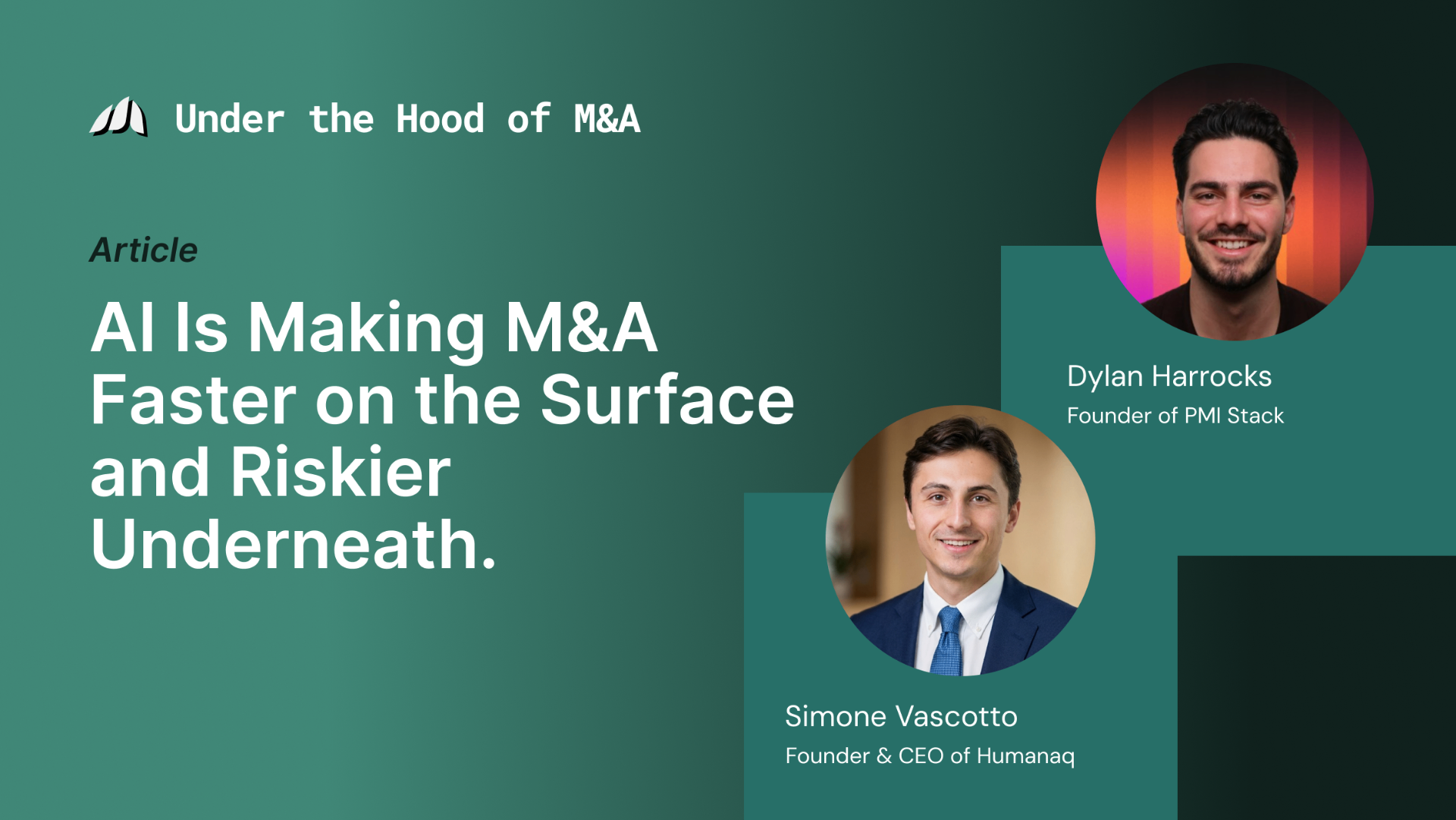
This piece distills a conversation with Dylan Harrocks, Founder of PMI Stack, on the Under the Hood of M&A series.
Faster, yes. But where does the risk go?
AI in M&A is making things faster. Deal sourcing, data room review, LOI drafting. The speed gains are real and measurable. The question Dylan and I raised is one the market is not asking carefully enough yet. When you compress a process, you do not eliminate the risk inside it. You move it somewhere.
"If you just over-automate, you see hiccups in a lot of places. Making mistakes in huge transactions can destroy a company."
The answer we kept coming back to is human-in-the-loop. Not as a temporary workaround until AI gets better, but as the architectural principle that keeps high-stakes decisions from being made by systems that do not understand what is at stake.
AI will hallucinate less as models improve. That is already happening. But better accuracy does not mean the human verification layer disappears. It means the human attention goes to the outputs that carry the highest consequence when they are wrong, rather than to the mechanical processing AI was always better suited for.
The time AI saves on document review should go toward sharper judgment on the findings that matter most. That is a better use of the deal professional's time. It is not the same as removing them from the process.
When AI becomes the nervous system of a company
This is the question I wanted to get to.
The standard technology diligence question is: what systems does the target use and what will it cost to integrate them? That question is becoming insufficient. A growing number of companies have AI embedded not just as tools people use but as the operating logic the workflow runs on. Prompts are the process documentation. Agents are handling tasks that used to belong to people. The AI is not adjacent to how the company works. It is how the company works.
When you acquire that company, you are not just buying a business with some software. You are buying a behavioral operating system built on a specific AI infrastructure. And if your integration plan treats that the same way it treats a CRM migration, you are going to destroy value.
Dylan drew a distinction between three types of AI-related acquisitions happening right now that I thought was useful. Acqui-hires where big tech buys a startup mostly for the IP and the team, with no real integration intent. Bolt-on tool acquisitions where a company buys an AI capability to add to its stack. And traditional business acquisitions where AI is a feature of the target but not the foundation.
The truly AI-native acquisition, where everything runs on agents and automations and the institutional knowledge lives in the prompts, is coming. It is probably a few years away in the PE rollup context. When it arrives, the standard playbook will not apply.
"If you're buying AI-native companies, you're probably going to lean on the minimum amount of integration as possible. Because if you have to integrate into your own processes, it has to be earned. There has to be a really good case as to why that would bring value instead of crushing value."
AI as a forcing function for documentation
Most integrations fail partly because the acquired company's processes are not documented. Sarah in marketing did things one way. Jimmy did them another. The company playbook describes a third thing. When you try to standardize, you are standardizing a fiction.
AI adoption changes this by necessity rather than intention. If you want AI agents to run your processes, those processes have to be defined clearly enough for the agents to follow. The prompt is the documentation. The workflow file is the process record.
Companies that have adopted AI seriously have, as a byproduct, produced something historically missing from most acquisition targets: a legible record of how things actually get done. Not how management believes they get done. How they actually get done.
There is an interesting pre-deal application here too. Sharing anonymized AI prompts and workflow structures during early diligence, stripped of identifying information, could reveal more about how a company operates than a management presentation ever could. How decisions get framed. What assumptions are baked into the operating logic. Where the leadership's actual priorities sit. All of it visible in how the AI has been configured, without needing interviews or a questionnaire.
For behavioral diligence, this is extremely interesting. The culture of an organization is increasingly embedded in its AI infrastructure. The prompts are the thought process made legible.
The one-time automation boom
The most forward-looking part of the conversation came from something Dylan had heard from a VC contact, a firm increasingly moving into rollup plays.
The opportunity to automate traditional service businesses, to take a company with 200 employees and rebuild it with five engineers and AI, is not a permanent window. It happens once, in a specific period, and then it is done. Dylan compared it to privatization booms. The opportunity exists while the transition is happening. Once the transition is complete and AI-automated businesses are the norm rather than the exception, the competitive advantage from having done it first compresses.
"This is only going to happen once. There's the same thing with AI-automated businesses. In fifty years it's going to be normal that you go to a law firm or an accountancy and AI covers most of that process."
What comes after the automation wave
I asked Dylan what levers private equity would use once most businesses have already been automated. It is a further-out question but worth thinking through now.
His answer was distribution.
Ten years ago in Silicon Valley the assumption was that more engineers meant more value. Hire as many developers as possible and scale through headcount. That logic is already shifting. When AI commoditizes output, meaning everyone can produce at roughly the same quality and speed, the advantage moves to who can get that output in front of the most clients.
"The synergies might not be buying the same types of businesses. It'll be buying businesses that are parallel to you and sharing clients between them."
If that is right, the M&A thesis in a future PE deal looks less like consolidation and more like distribution expansion. You are not buying a similar business to cut costs. You are buying a business with a different client base and running both through the same AI infrastructure. The value is in the shared distribution, not the operational overlap.
I do not know if that is exactly right. Neither does Dylan. But it is the kind of thinking that practitioners building AI-enabled businesses now probably need to be doing, because by the time the automation wave has crested the positioning window for what comes next will have already narrowed.
Frequently Asked Questions
- Does AI reduce M&A risk?
- AI reduces certain kinds of friction and speeds up mechanical work like document review and LOI drafting. It does not reduce overall risk. It relocates it, typically concentrating risk at the points where human judgment was previously catching errors before they propagated.
- What does human-in-the-loop mean in M&A?
- Human-in-the-loop is an architectural choice to keep human verification on the outputs that carry the highest consequence when wrong. As AI accuracy improves, the human attention shifts from mechanical review to judgment on findings that materially affect the deal.
- What is an AI-native acquisition target?
- An AI-native target is a company where AI is not adjacent to operations but is the operating logic itself. Prompts are the process documentation, agents handle tasks that used to belong to people, and the institutional knowledge lives in the AI infrastructure.
- Why is heavy integration risky with AI-native targets?
- AI-native companies have a behavioral operating system built on specific infrastructure. Forcing them into a standard integration playbook can destroy the value you bought. The case for integration has to be earned rather than assumed.
- What changes in PE strategy after the automation wave?
- When AI commoditizes output, the advantage moves from production to distribution. The M&A thesis shifts from consolidating similar businesses to acquiring parallel businesses with different client bases and running them through shared AI infrastructure.