Key Takeaways
- 1.Build a system that tracks AI developments for you and surfaces only what is relevant to your specific workflows.
- 2.For confidential deal materials, a locally hosted knowledge base like Obsidian is more secure than cloud notebooks.
- 3.Start with Claude skills for repeat tasks before moving to MCP connections, plugins, and agents.
- 4.Vet AI tools by their foundation and methodology first, then validate through direct hands-on testing.
- 5.Pick one primary LLM and stick with it for six months. The compounding context is the advantage.
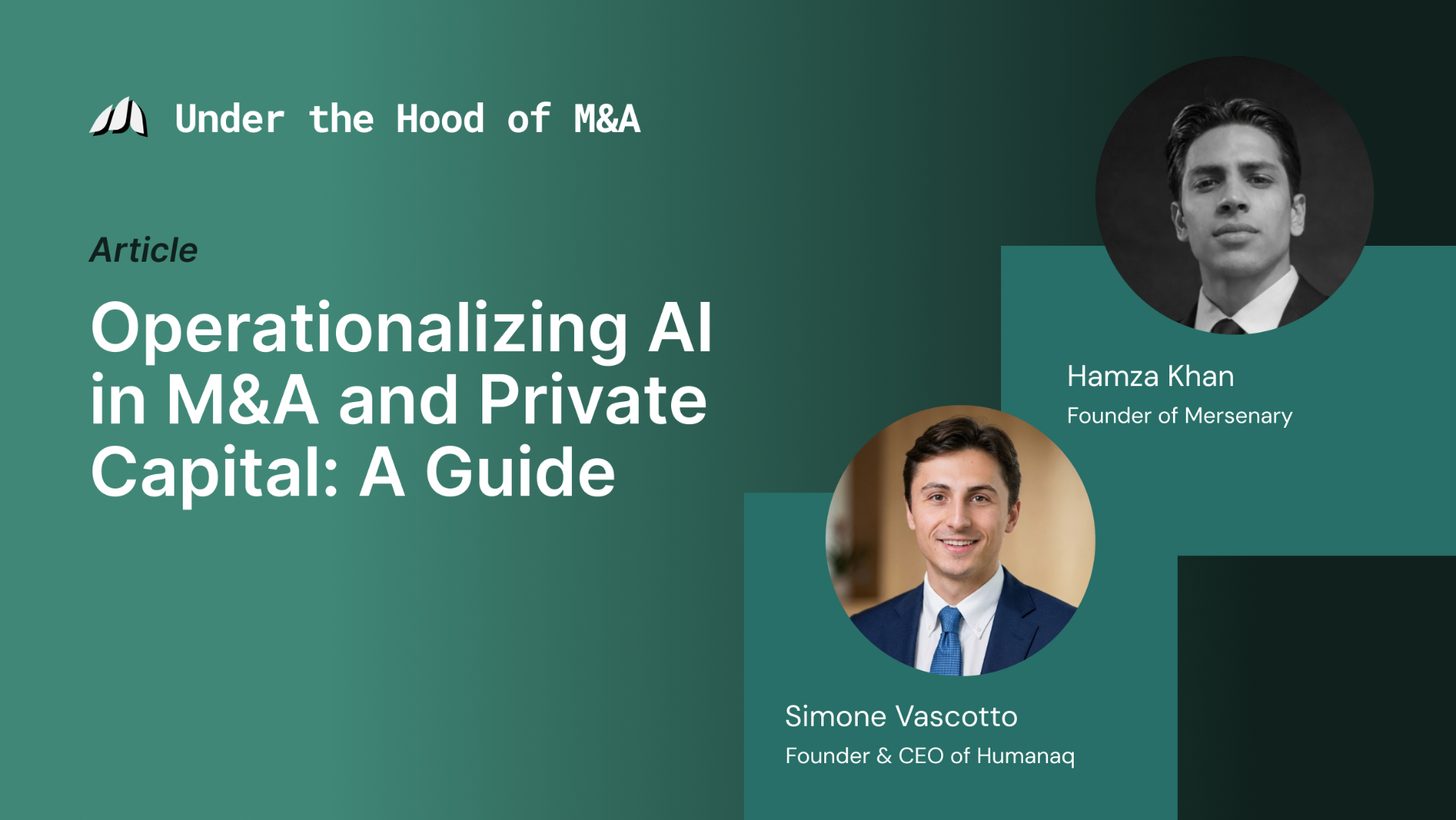
I had a conversation with Hamza Khan who builds AI solutions for private capital firms with Mersenary. What came out is one of the most practical deep dives of AI in M&A.
How to keep up without losing your mind
The volume of new AI developments is genuinely unmanageable if you try to track everything. The answer is not to try.
One approach worth understanding: build a system that does the tracking for you and surfaces only what is relevant to your specific workflows. An automated agent running every morning that scans news feeds, social platforms, and relevant sources, then returns a prioritized list ranked by how useful each development is for your specific context. Not a general AI news digest. A workflow-relevant brief.
The output feeds into a local knowledge base, in this case Obsidian, where interesting items get tagged for further exploration. The key distinction is that the information compounds. Every time you explore a tool and form a view on it, that view goes back into the knowledge base. The system gets smarter as you use it because it accumulates your specific judgments rather than starting fresh each day.
"Most people are just scrambling to use five different tools for five different workflows. If you're smart about which workflows you pick and what tooling you use, you'll be orders of magnitude better than that."
The morning brief, the local knowledge base, the deliberate exploration and feedback loop. That workflow costs almost nothing to set up and solves the problem most practitioners describe as one of their biggest: how to stay current without it consuming the entire day.
NotebookLM vs Obsidian: when to use which
Both tools function as private knowledge environments. You put documents in, you ask questions, you get answers drawn only from what you provided. For anyone working with confidential deal information, this closed-loop behavior is the point.
The distinction worth understanding is where the data actually sits.
NotebookLM runs on Gemini in the background. Anything you upload is technically processed by Google's infrastructure. For general research, YouTube video synthesis, or learning from public content, this is fine. For confidential deal documents, it raises a legitimate question about whether you want that data processed by an external model provider.
Obsidian is locally hosted. It is a file organization system that lives on your computer. When you connect an LLM to it, the LLM reads your files but does not store them. The intelligence stays local. The files never leave your machine.
"The security problem just vanishes with Obsidian because all of the files are on your laptop. You're just using an LLM to process those files. The LLM doesn't store any of them."
For M&A contexts specifically, where document confidentiality is not optional, Obsidian connected to Claude through local file access is a meaningfully more secure setup than NotebookLM for data room materials. Both are useful. The right one depends on what you are putting into it.
Operationalize AI in day-to-day deal workflow
The most common failure mode: practitioners understand that AI could help their workflow but cannot translate that understanding into specific changes to how they work on Monday morning.
The starting point is describing your daily workflow to Claude in detail: this is what I do when I arrive at the office, this is what takes the most time, this is where I lose the most hours to mechanical work. Tell it your current level of AI familiarity. Then ask: how much of this can I automate, and where should I start?
The output will be more useful than any generic guide, because it is built on your specific context rather than a general model of how M&A professionals work. From there, the progression that actually works:
Start by building skills in Claude. A skill is a reusable instruction set that tells Claude how to handle a specific recurring task. Spend one week building skills for the three or four tasks you repeat most often in your deal workflow. Nothing else. Just that.
Once skills are working, move to MCP connections. This is how Claude connects to external tools and data sources. Then move to plugins, then simple agents, then agent teams.
Do not jump to the complex end of this stack. Every practitioner who has tried to start with agents and Claude Code before understanding skills has spent three times as long getting to a working result. The foundation matters.
Vetting AI tools in a high-stakes environment
In consumer contexts you can just pick up a tool and try it. In B2B M&A, you cannot run experiments on live deals. The stakes are too high and the cost of a mistake in a live transaction is significant.
Two approaches work in combination.
Look at the foundation. Who built it. What the scientific or methodological basis is. Whether the people behind it have genuine domain expertise in M&A or just AI expertise. In a market flooded with tools that are a prompt and a logo, this filter removes most of what should be removed.
But do not rely only on pedigree. Some genuinely useful tools are built by people without impressive credentials. And some well-funded, well-credentialed products do not work in practice. Where the stakes allow experimentation, direct hands-on testing is the most reliable signal.
"A lot of useless stuff is getting funded by really good VC houses. I wouldn't entirely bank my opinion on who's backing a tool. I would just pick it up and use it."
The combination: foundation check first to eliminate obvious noise, direct testing second for anything that passes that filter.
For practitioners buying AI tools, this is a useful filter. The question to ask of any AI product you are evaluating: what is the underlying thing here that cannot be replicated with a general LLM subscription? If the answer is unclear, the product's shelf life may be shorter than its sales cycle. The tools with genuine moats are the ones built on proprietary data, validated methodology, or domain expertise that cannot be scraped together in an afternoon.
The tool fatigue trap is real
There is a cycle happening in AI adoption that most practitioners fall into without realizing it.
This month it is OpenAI. Next month something new drops and you switch. The month after that you hear about another platform and move again. Six months pass. You have five subscriptions, a dozen half-built workflows, and no meaningful change in how your deals run.
"Stick to one of the big houses. Pick OpenAI, pick Claude, pick one of them and stick to them for six months. See what they actually do for you on a revenue-based, targeted level."
That is harder than it sounds when something new drops every week. But the practitioners generating real results from AI in deal work are almost universally the ones who went deep on one system rather than wide across many. The context you build up inside a single platform, the memory, the skills, the workflows, compounds. Constantly switching resets that compounding to zero.
A practical rule of thumb: subscribe to two LLMs maximum. One primary platform where you build everything. One secondary to cross-check outputs on high-stakes work.
If everyone has AI, where is the leverage?
If every practitioner eventually has access to similar AI tools and the production cost of AI-assisted work flattens, what creates advantage?
The answer is not technical. It is the same thing that has always created advantage in M&A: relationships, experience, and judgment. Who you know. How long you have been in the game. The pattern recognition built from having seen enough deals to know what matters and what does not.
"In a world where everyone has equal access to intelligence, what separates a successful person from a not successful person is experience and connections."
AI removes the excuse of not having the tools or not having the team. It does not remove the requirement for genuine domain expertise. The practitioners who will look back at this period as formative are the ones who used the efficiency AI created to go deeper on the judgment layer, not the ones who used it to do more shallow work faster.
That is the real opportunity in this market. Not keeping up with every new tool. Going deeper on the work that matters.
Frequently Asked Questions
- How should I keep up with new AI developments without it consuming my day?
- Build an automated agent that scans news, social, and relevant sources each morning and returns a prioritized brief ranked by relevance to your workflows. Feed interesting items into a local knowledge base that compounds over time.
- Is NotebookLM or Obsidian better for deal work?
- NotebookLM is fine for general research and public content but processes data through Google's infrastructure. For confidential M&A documents, Obsidian connected to a local LLM keeps files on your machine and is meaningfully more secure.
- Where should I start operationalizing AI in deal workflow?
- Describe your daily workflow to Claude, then build skills for the three or four tasks you repeat most often. Once skills work, layer in MCP connections, then plugins, then simple agents. Do not start at the complex end.
- What creates advantage if everyone has the same AI tools?
- The same things that always have: relationships, experience, and judgment. AI removes the excuse of not having tools or team. It does not remove the requirement for genuine domain expertise.